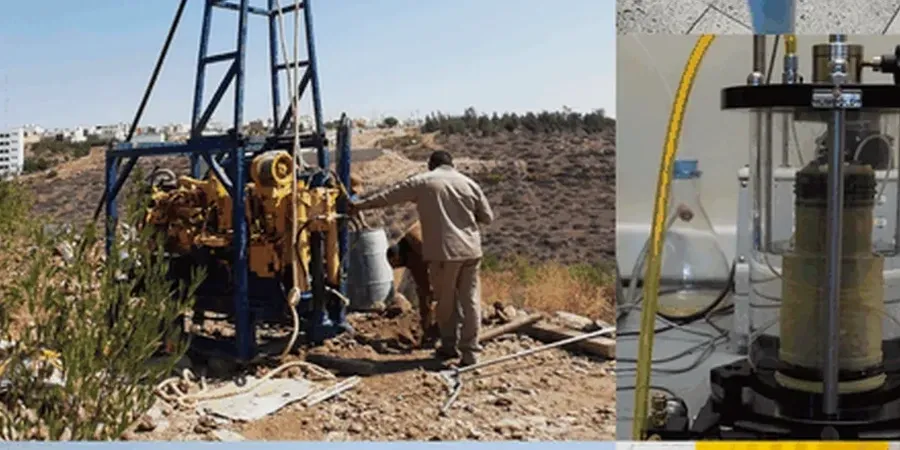
Our Auckland office provides comprehensive geotechnical services tailored to the city's unique geological and regulatory landscape. We specialize in site characterization, foundation design, subsurface investigation, and construction monitoring, ensuring that every project is built on a solid understanding of local ground conditions. By leveraging consolidated regional experience and calibrated equipment, we deliver code-compliant reports that meet New Zealand standards. Whether you are planning a residential development or a commercial infrastructure project, our team offers the expertise needed to navigate Auckland's complex subsurface environment. Learn more about our seismic amplification analysis and other specialized services.
Technical reference image — Auckland
Method and coverage
Auckland's subsurface is dominated by the Waitemata Group, a sequence of Miocene-aged sandstones, siltstones, and conglomerates that underlie much of the central isthmus. These sedimentary rocks are often overlain by volcanic deposits from the Auckland Volcanic Field, including scoria cones, lava flows, and tuff rings, which create highly variable ground conditions. In coastal areas and river valleys, Quaternary alluvial and estuarine sediments such as soft clays, silts, and peat are common, often associated with high groundwater tables and potential for settlement. The region also experiences active seismicity due to the Hikurangi subduction zone, with earthquake hazards including ground shaking and liquefaction in loose, saturated sands. Understanding these conditions is critical for foundation design and slope stability, and we integrate this knowledge into our geotechnical road drainage solutions.
Regional considerations
Our team brings extensive regional experience to Auckland projects, having worked across the North Island's diverse geological settings. We operate a calibrated laboratory that performs site-specific index and strength testing, ensuring data accuracy for design. Our close coordination with local councils, contractors, and regulatory bodies streamlines consenting processes and construction oversight. By combining local knowledge with rigorous compliance to New Zealand codes, we deliver reliable geotechnical solutions that mitigate risk and support project success.
Our work in Auckland adheres to New Zealand standards, primarily NZS 1170.5 for seismic actions and NZS 3604 for timber-framed buildings (where applicable). For deep foundations and retaining structures, we follow NZS 4230 for masonry design and NZS 3101 for concrete structures. We also reference international standards such as AS/NZS 1289.6.3.1 for Standard Penetration Tests and NZS 4402 for soil classification. All investigations and reports comply with the New Zealand Geotechnical Society guidelines, ensuring solid, defensible recommendations for local projects.
FAQ
What are the most common geotechnical challenges for foundations in Auckland?
Auckland's variable geology—from volcanic rock to soft estuarine clays—often requires tailored foundation solutions. Challenges include high groundwater in coastal areas, liquefaction risk in loose sands, and variable bearing capacity due to buried volcanic deposits. Our site investigations address these through targeted drilling, In-Situ, and laboratory analysis.
How does the Auckland Volcanic Field affect geotechnical design?
The volcanic field introduces heterogeneity, with scoria, tuff, and lava flows interbedded with sedimentary rocks. These materials have highly variable strength and compressibility. We use geophysical methods like seismic refraction and careful drilling to map these layers, ensuring foundation designs account for abrupt changes in ground conditions.
What New Zealand standards govern geotechnical reporting in Auckland?
Geotechnical reports must comply with NZS 1170.5 for seismic design, NZS 3604 for lightweight structures, and NZS 4230 for masonry. The New Zealand Geotechnical Society's guidelines on site investigation and reporting are also widely adopted. Our reports are structured to meet these requirements, facilitating council approvals.
Do you provide construction monitoring services for Auckland projects?
Yes, we offer construction monitoring including compaction testing, pile installation verification, and groundwater level observation. We work alongside contractors to ensure that design assumptions are validated during construction, reducing the risk of unforeseen ground conditions. This service is particularly valuable on sites with variable volcanic or alluvial deposits.
Location and service area
We serve projects across Auckland and surrounding areas.