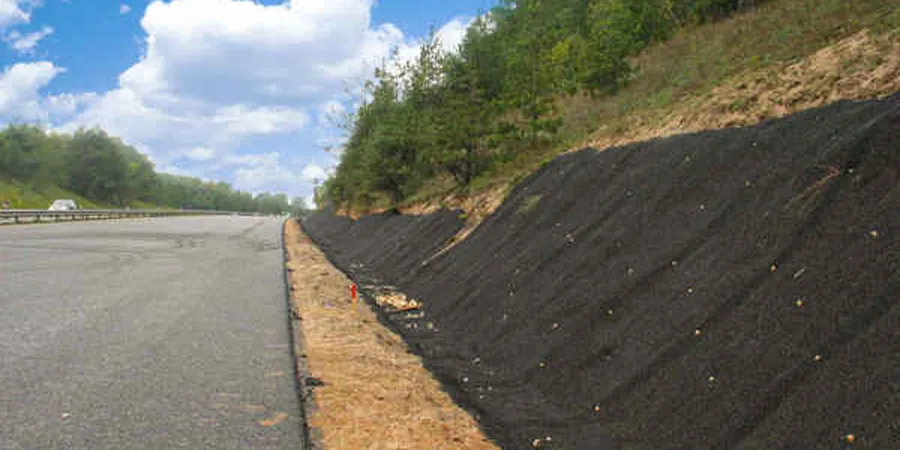
A recent project on State Highway 1 near the Bombay Hills required a 14-meter-high embankment over soft alluvial deposits. The client needed a design that would not creep during the wet winters. We ran a full field investigation including boreholes and undisturbed sampling. The key was understanding the preconsolidation pressure of the underlying clays. Before any fill placement, we complemented the investigation with a subgrade evaluation to confirm the foundation bearing capacity. Without that step, differential settlement would have compromised the pavement within two years. Road embankment design in Auckland demands this level of rigor because the geology varies sharply within a few hundred meters.
Auckland's volcanic geology means basalt, pumice sands, and soft marine clays can appear within the same road alignment.
Method and coverage
Auckland's volcanic geology means you can encounter basalt rock, pumice sands, and soft marine clays in the same alignment. We always start with a site-specific classification of the borrow material. The design then follows a staged construction approach with settlement monitoring plates. We use the Casagrande method to interpret consolidation test results from undisturbed tube samples. For the fill itself, we specify compaction to 95% of standard Proctor density, verified by field density tests. When the borrow material is too wet, we incorporate compaction stabilization to improve workability. The typical design sequence includes:
Geotechnical investigation with CPT and SPT borings
Consolidation testing for settlement magnitude and rate
Stability analysis using Bishop's simplified method
Drainage layer design with geotextile separation
Each parameter feeds directly into the embankment geometry and construction schedule.
Technical reference image — Auckland
Regional considerations
Auckland's subtropical climate delivers over 1200 mm of rain annually, concentrated in autumn and winter. This saturates the fill material and elevates pore pressures during construction. If the embankment is built too fast, the undrained shear strength of the foundation soil can be exceeded, triggering a rotational failure. We have seen this happen on a residential subdivision in Flat Bush where the contractor placed 4 meters of fill in one week. The slide cost the developer six months and $180,000 in remediation. In road embankment design for Auckland, the combination of high rainfall and soft Waitemata Group sediments makes staged construction and drainage control non-negotiable.
Granular (GW/GP) to cohesive (CL/CH) per NZGS guidelines
Compaction requirement
95% standard Proctor (NZS 4402)
Allowable settlement
25 mm total, 15 mm differential over 20 m
Factor of safety (long-term)
1.5 minimum (Bishop's method)
Drainage layer thickness
300 mm minimum, 5% slope to outlets
Geotextile separation
Class A (high-strength woven) below fill
Related services
01
Geotechnical Investigation for Embankments
We drill boreholes and perform CPT soundings to profile soil layering and obtain undisturbed samples. Laboratory testing includes consolidation, triaxial, and index properties. All work follows NZS 4402 and ASTM standards.
02
Stability and Settlement Analysis
Using limit equilibrium software (Slide2) and finite element modeling (Plaxis 2D), we compute factors of safety for rotational and translational failure modes. Settlement magnitude and time-rate curves are generated from oedometer test data.
03
Construction Monitoring and QA
Our field technicians verify compaction density, moisture content, and fill placement rates. We provide daily reports and adjust the design if field conditions deviate from assumptions. This reduces the risk of post-construction distress.
Standards that apply
NZS 4402:1986 (Methods of testing soils for civil engineering purposes), NZGS 2005 (New Zealand Geotechnical Society guidelines for slope stability), NZS 4402 (Standard test method for one-dimensional consolidation properties of soils), FHWA-NHI-05-039 (Mechanistic-empirical design for embankments)
FAQ
What is the typical cost range for road embankment design in Auckland?
The cost for a complete geotechnical design package, including investigation, laboratory testing, and analysis, typically falls between NZ$1,790 and NZ$7,920. The final price depends on the embankment height, length, and complexity of the subsurface conditions.
How long does the design phase usually take?
A straightforward embankment design for a 200-meter road section can be completed in 3 to 4 weeks. Complex sites with soft clay or variable geology may require 6 to 8 weeks to allow for consolidation testing and iterative stability analysis.
What happens if the foundation soil is too weak to support the fill?
We evaluate Improvement options such as surcharging with wick drains, stone columns, or lightweight fill (e.g., expanded polystyrene geofoam). The choice depends on the site-specific soil strength, project timeline, and budget constraints.
Do you provide a warranty for your embankment designs?
Our designs are prepared by Chartered Professional Engineers (CPEng) and include a geotechnical baseline report. The design is warranted to meet the specified factors of safety and settlement criteria. Post-construction monitoring can be arranged to verify performance.
Location and service area
We serve projects across Auckland and surrounding areas.