A portable seismograph array is deployed across your Auckland site to record ambient vibrations. The equipment captures shear wave velocity profiles using the MASW method, which is essential for identifying soil layers that can amplify earthquake motions. This data feeds directly into a one-dimensional ground response analysis. Before finalizing foundation design, the team often cross-references results with a MASW-Vs30 study to validate stiffness profiles. Auckland sits on the Auckland Volcanic Field, where variable basalt and tephra deposits create sharp impedance contrasts — exactly the conditions that produce unexpected amplification. Understanding these contrasts early avoids costly redesigns later.
Auckland's volcanic stratigraphy creates impedance contrasts that can double peak ground acceleration on soft soil sites during a subduction earthquake.
Method and coverage
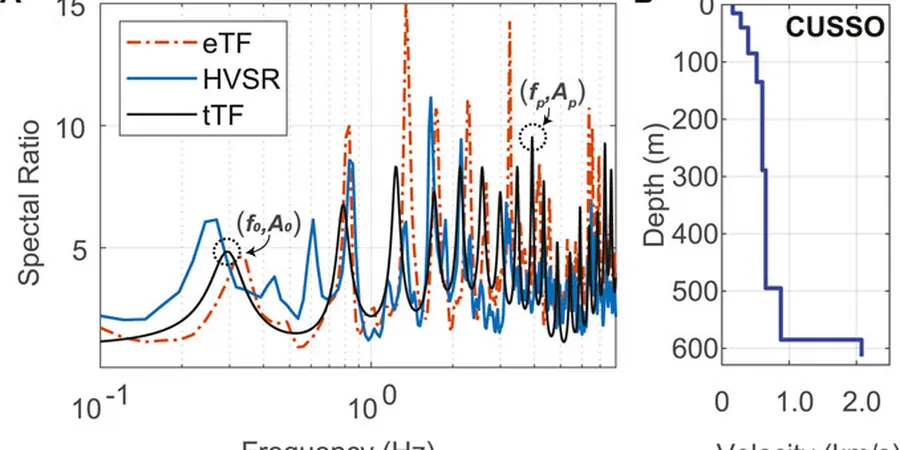
Comparing the Waitematā Harbour shoreline with the central isthmus reveals stark differences in seismic behavior. Soft marine sediments near the waterfront amplify long-period waves, while the volcanic basalt ridges of Mount Eden and One Tree Hill produce shorter, sharper ground motions. A proper seismic amplification analysis in Auckland must account for this lateral variability. The workflow combines shear wave velocity measurements with site-specific transfer functions. For deep soft soils, engineers typically run equivalent-linear SHAKE analyses. Where stiff crust overlies loose fill, a microtremor HVSR survey helps define the fundamental frequency. Results are then integrated with cimentaciones sismicas to match foundation stiffness to the expected response spectrum. This layered approach ensures no buried channel or old quarry fill goes unaccounted.
Technical reference image — Auckland
Regional considerations
NZS 4203 requires site-specific seismic hazard analysis for important structures in Auckland, but many developers underestimate local amplification. The Auckland Volcanic Field creates a mosaic of hard lava flows interbedded with soft scoria and alluvial silt. During an Alpine Fault or Hikurangi subduction earthquake, these layers can trap and amplify seismic waves unpredictably. A standard building code response spectrum may underestimate actual accelerations by 40% on reclaimed land along the Viaduct Harbour or in the Ponsonby gullies. The seismic amplification analysis in Auckland directly addresses this gap by computing site-specific transfer functions rather than relying on generic site classes.
Non-invasive surface wave array for vs30/" data-interlink="1">shear wave velocity profiles up to 40 m depth. The method maps Vs30 values used for NZS 4203 site classification and identifies low-velocity layers that control amplification.
02
1D Ground Response Analysis
Equivalent-linear and nonlinear SHAKE-type analyses using recorded acceleration time histories scaled to Auckland's seismic hazard. Output includes acceleration response spectra and time histories for structural design.
Standards that apply
NZS 4203:1992 (General structural design and seismic loading), ASCE/SEI 7-22 Section 21.1 (Site-specific ground motion procedures), NZS 4402/D4428M-14 (Crosshole seismic testing), NEHRP Recommended Provisions for New Buildings
FAQ
How does Auckland's volcanic geology affect seismic amplification?
The Auckland Volcanic Field produces alternating layers of hard basalt and soft scoria/tuff. These impedance contrasts cause seismic waves to resonate within the softer layers, amplifying ground motion at specific frequencies. A site-specific analysis captures these local effects that the code's generic site class cannot.
What is the typical cost range for a seismic amplification analysis in Auckland?
For a standard residential or commercial site in Auckland, the cost ranges between NZ$1,560 and NZ$3,040, depending on the number of MASW arrays and the complexity of the ground response modeling. Larger or multi-site projects may fall outside this range.
When is a site-specific response analysis required by New Zealand standards?
NZS 4203 requires site-specific analysis for structures with an importance level of 3 or higher, and for any building on soft soil (site class D or E) in high seismic zones. Auckland's moderate seismicity still demands this analysis for critical infrastructure like hospitals, bridges, and emergency facilities.
Location and service area
We serve projects across Auckland and surrounding areas.