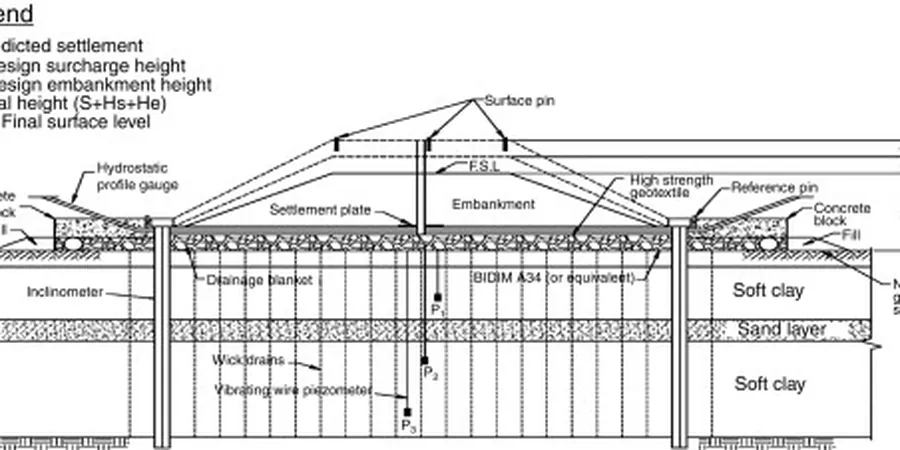
The crawler excavators and dump trucks we mobilise across Auckland's volcanic fields are often fitted with GPS-guided grade control to place fill layers precisely. For preloading with surcharge design, the team first surveys the site's existing topography, then coordinates with the compaction crew to spread and compact a staged embankment using granular material sourced from local quarries like those on the Hibiscus Coast. A vibrating roller passes over each lift, and settlement plates are installed at regular intervals. Before the main surcharge goes on, we often run a plate load test to calibrate the stiffness of the founding subgrade. The entire process is monitored daily with survey prisms and piezometers, ensuring the design's target pre-consolidation pressure is achieved before any foundation work begins.
In Auckland's soft volcanic clays, a 5-metre surcharge held for six months typically achieves 90% primary consolidation, reducing post-construction settlement to under 25 mm.
Method and coverage
Auckland's rapid post-war suburban expansion, especially into the Isthmus and along the southern motorway corridor, pushed developments onto deep alluvial and volcanic ash deposits with high compressibility. Those soils, often less than 5,000 years old, exhibit significant secondary compression under sustained load. Preloading with surcharge design in Auckland relies on careful estimation of the coefficient of consolidation (cv) from oedometer tests on undisturbed samples. A typical surcharge height ranges between 2 and 6 metres, with a holding period of three to nine months. The design must also account for the underlying Waitemata Group sandstone where it acts as a drainage layer. Combining preloading with vertical drains is common when the clay layer exceeds 8 metres and drainage paths need shortening. The geotechnical team cross-checks predicted versus measured settlement every 30 days to adjust the surcharge schedule if needed.
Technical reference image — Auckland
Regional considerations
A common mistake we see from contractors in Auckland is removing the surcharge too early based on surface settlement alone. Without pore pressure dissipation data, a reading that looks complete might only reflect 60% consolidation. If the surcharge is taken off prematurely, the underlying clay rebounds elastically and the long-term settlement under the permanent load will exceed the design tolerance. That leads to cracked floor slabs, misaligned services, and costly remediation. The correct approach is to monitor both settlement plates and vibrating-wire piezometers until the measured excess pore pressure drops below 10% of the applied load. Only then is the surcharge removed and the site handed over for construction.
Boreholes, undisturbed sampling, and In-Situ to characterise the compressible layers and determine the depth to competent bearing strata.
02
Consolidation testing and parameter derivation
Oedometer tests on undisturbed samples to obtain cv, Cc, Cr, and σ'p, used directly in the surcharge design calculations.
03
Settlement monitoring and surcharge schedule
Installation of settlement plates, piezometers, and survey targets; weekly data review to adjust the holding period and surcharge height.
Standards that apply
NZS 4203:1992 (General structural design and actions), NZS 3404:1997 (Steel structures – surcharge frame references), NZGS Guideline for Consolidation and Settlement Analysis (2019)
FAQ
How long does a typical preloading with surcharge program take in Auckland?
For most Auckland sites with soft volcanic clays, the holding period ranges from three to nine months. The exact duration depends on the clay layer thickness, the coefficient of consolidation, and the target pre-consolidation pressure. We monitor settlement and pore pressure weekly to confirm when 90% primary consolidation is reached.
What is the typical cost range for a preloading with surcharge design in Auckland?
The cost for a preloading with surcharge design package in Auckland typically falls between NZ$1.360 and NZ$3.950, depending on the number of boreholes, laboratory tests, and the complexity of the surcharge schedule. This includes field instrumentation and two months of monitoring data review.
Can preloading with surcharge be combined with vertical drains in Auckland?
Yes, combining preloading with vertical drains is standard practice when the compressible clay layer exceeds eight metres. The drains accelerate pore water dissipation by shortening the drainage path horizontally, reducing the holding period from over a year to four to six months. The design then accounts for radial consolidation in addition to vertical consolidation.
What happens if the surcharge is removed too early in Auckland?
Removing the surcharge before excess pore pressures have fully dissipated causes the clay to rebound elastically. When the permanent structural load is applied later, the soil will re-compress, leading to post-construction settlements that can exceed 50 mm. This often results in cracked slabs, misaligned foundations, and expensive remedial grouting.