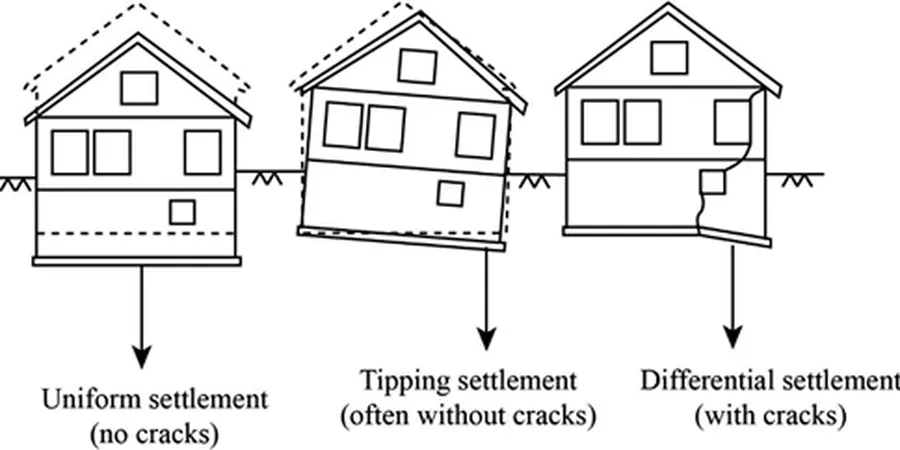
In Auckland, we see it time and again: structures settle unevenly because the ground beneath them is anything but uniform. The city’s unique geology — a patchwork of volcanic basalt, marine sediments, and soft alluvial deposits along the Waitematā Harbour — means that two points just a few metres apart can have completely different bearing capacities. That is why a thorough differential settlement analysis is essential before any foundation design. Without it, you risk cracks in walls, jammed doors, and costly structural repairs down the line. We combine local experience with field data from geotechnical instrumentation and lab testing to predict how much each part of a building will move relative to the next. Our team has assessed sites across Auckland’s volcanic fields and the reclaimed land of the Viaduct Basin, so we understand the patterns that cause trouble.
Uneven ground demands uneven attention: a metre of volcanic tuff can mask a metre of soft marine clay below.
Method and coverage
Auckland sits on the Auckland Volcanic Field, with over 50 eruption centres that left behind scoria cones, lava flows, and tuff rings — all highly variable in stiffness and compressibility. Beneath the CBD, reclaimed land and marine clays can settle under load for decades. Our analysis accounts for these local quirks. We measure layer thickness via boreholes and use consolidation tests to predict settlement magnitude and rate. The key parameters we evaluate include:
Compression index (Cc) and recompression index (Cr) from oedometer tests
Pre-consolidation pressure (σ'p) to identify overconsolidated vs normally consolidated strata
Coefficient of consolidation (cv) for time-rate predictions
Modulus of subgrade reaction (ks) for raft and mat foundations
All results are compared against NZS 4203:1992 loadings and NZGS guidelines for tolerable movements. For deep fills or highly compressible layers, we often recommend preloading with surcharge to accelerate primary consolidation before construction.
Technical reference image — Auckland
Regional considerations
The biggest risk in Auckland is the hidden variability. You might be drilling into what looks like competent Waitematā sandstone, only to hit a soft volcanic ash lens that extends laterally for 20 metres. Our rigs carry continuous soil samplers and piezocone probes that map these changes in real time. We also assess the risk of liquefaction-induced settlement in areas like the isthmus, where loose sands and high water tables combine. When we find problematic layers, we model the differential movement using finite-element software and compare it to the structure’s tolerance. For sensitive projects, we install settlement markers and inclinometers to monitor actual behaviour during and after construction — feeding that data back into the analysis to refine predictions.
Continuous core and disturbed sampling using solid-flight augers and thin-wall tubes, targeting key strata identified in the geological map of Auckland.
02
Consolidation Testing (Oedometer)
Multi-stage incremental loading tests to determine Cc, Cr, and cv, with results correlated to field conditions using empirical correction factors.
03
Numerical Settlement Modelling
2D and 3D finite-element analysis using Plaxis or similar, calibrated against local case histories from the Auckland region.
This service complements our laboratory testing work for a complete project analysis.
Standards that apply
NZS 4203:1992 – General structural design and loadings, NZGS 2016 – Geotechnical site investigation guidelines, NZS 4402 – Standard test method for one-dimensional consolidation, AS 1289.6.6.1 – Methods of testing soils: consolidation test
FAQ
What causes differential settlement in Auckland soils?
The main causes are the high lateral variability of volcanic and alluvial deposits, compressible marine clays under the CBD, and the presence of loose sands that can settle under cyclic loading. Even a thin clay lens sandwiched between stiff layers can produce noticeable movement.
How much does a differential settlement analysis cost in Auckland?
A typical analysis for a medium-sized residential or commercial project ranges from NZ$1.110 to NZ$3.000, depending on the number of boreholes, lab tests required, and the complexity of the ground model. We provide a fixed-price quote after reviewing the site geology.
What is the difference between total settlement and differential settlement?
Total settlement is the absolute downward movement of a point, while differential settlement is the difference in movement between two points. The latter causes structural distress: if one column settles 20 mm and another 40 mm, the 20 mm difference can crack beams and slabs. Our analysis focuses on the relative movements that matter for serviceability.
Location and service area
We serve projects across Auckland and surrounding areas.