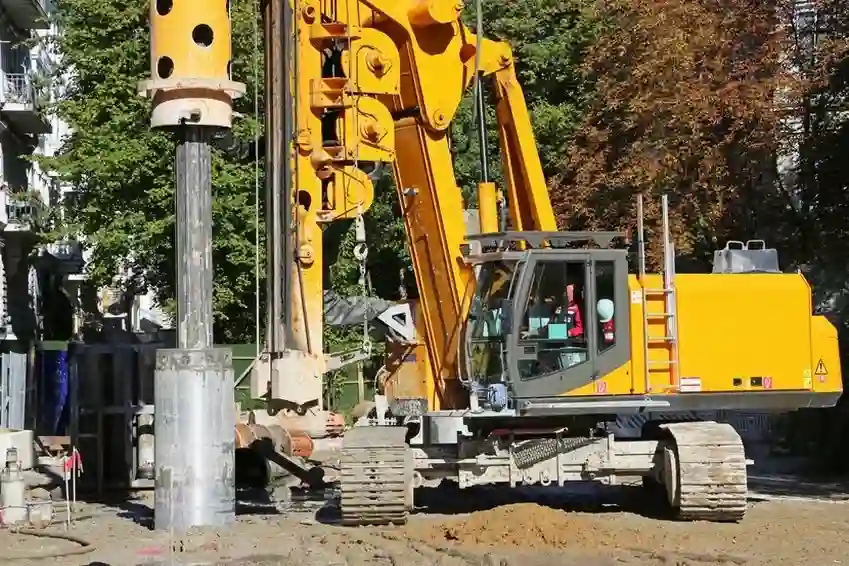
Auckland’s explosive growth since the 1950s transformed its volcanic landscape into a sprawling urban network, with suburbs climbing the basalt ridges and filling the intertidal estuaries. The city sits on a mosaic of weathered Waitemata Group sandstones, soft alluvial clays, and pyroclastic deposits from the Auckland Volcanic Field — each layer bearing differently under load. Our team has assessed bearing capacity across this complex geology for over a decade, correlating plate load tests with local soil maps to deliver foundation designs that match the actual ground conditions. Before any structural design, we recommend coupling our analysis with micropile verification for sites where thin lava flows overlie soft sediments, ensuring the load path reaches competent strata.
One in five Auckland projects faces a hidden weak layer beneath competent surface soil — our bearing capacity analysis exposes it before the foundation is poured.
Method and coverage
In Auckland, we frequently encounter a stiff crust of volcanic ash over soft marine clays — a classic two-layer system that demands careful bearing capacity evaluation. Our approach combines In-Situ (plate load tests per NZS 4402, CPTu soundings) with laboratory strength parameters from undisturbed samples. The analysis follows NZS 3404:2007 for structural interaction and NZGS guidelines for shallow foundations on volcanic soils.
Settlement estimates under working loads (elastic and consolidation)
Allowable bearing pressure for Serviceability Limit State
For projects on the Central Isthmus or North Shore, where residual soils overlie basalt, we integrate MASW-Vs30 profiling to capture stiffness variability at depth — a critical input for both static and seismic bearing checks.
Technical reference image — Auckland
Regional considerations
A common mistake we see on Auckland building sites is assuming the bearing pressure from a geotechnical desk study applies uniformly across the whole lot. Developers often skip localized testing near old stream channels or buried tuff cones, only to find differential settlements cracking slabs within the first year. Without site-specific bearing capacity analysis, you risk overstressing a lens of soft alluvial clay while the adjacent footing sits on firm basalt — the resulting differential movement can exceed 50 mm. We have documented cases in Ponsonby and Mount Eden where ignoring this variability led to structural damage costing over $80,000 to remedy.
NZGS 2016 Technical Guideline for Bearing Capacity
Seismic check
NZS 1170.5:2004 for liquefaction & cyclic softening
Typical turn-around
10–15 working days from field completion
Related services
01
Shallow Foundation Bearing Capacity
In-situ plate load tests combined with laboratory triaxial (CU, CD) and direct shear on undisturbed samples. We calculate ultimate and allowable bearing pressures per NZGS guidelines, including settlement analysis for Serviceability Limit State. Ideal for pad footings, strip footings, and raft foundations on Auckland’s stiff clays and residual soils.
02
Deep Foundation Bearing Capacity
For sites requiring piles or piers — driven, bored, or screw piles — we perform PDA testing, CAPWAP analysis, and static load tests (NZS 4402) to verify end-bearing and shaft friction. We correlate CPTu and SPT data with local pile load databases from the Auckland region to refine capacity estimates for volcanic soils and alluvial deposits.
Standards that apply
NZS 3404:2007 (Steel structures interaction with foundations), NZS 1170.5:2004 (Structural design actions – earthquake), NZGS 2016 Technical Guideline for Bearing Capacity of Shallow Foundations, NZS 4402 (Plate load test for bearing capacity)
Process video
FAQ
What is the typical cost range for a bearing capacity analysis in Auckland?
For a standard residential site with 2–3 plate load tests and laboratory strength testing, the cost ranges between NZ$1.100 and NZ$3.140 depending on site access, number of test locations, and whether CPTu soundings are included. Larger commercial developments with multiple boreholes and advanced triaxial testing can exceed this range. Each project is quoted based on scope and ground conditions.
How is bearing capacity analysis different from a standard soil test?
A standard soil test identifies soil type and basic index properties (moisture, density, Atterberg limits). Bearing capacity analysis goes further — it determines the maximum load the soil can carry without shear failure or excessive settlement. This requires in-situ plate load tests or CPTu soundings, laboratory strength tests (triaxial, direct shear), and calculations per NZS 3404 and NZGS guidelines to assign an allowable bearing pressure for design.
Do I need bearing capacity analysis for a minor dwelling or granny flat in Auckland?
Yes, under the Auckland Unitary Plan and NZS 4203, any new foundation must be designed for the site’s specific bearing capacity. Even minor dwellings on shallow foundations require at least one plate load test or a verified soil report to confirm the allowable bearing pressure. Skipping this step risks differential settlement, especially on Auckland’s volcanic ash and soft alluvial soils, and may delay building consent.
What factors affect bearing capacity in Auckland’s volcanic soils?
Auckland’s volcanic soils — tuff, scoria, and basalt-derived clays — exhibit high variability in strength and stiffness. Key factors include: degree of weathering (fresh basalt vs. highly weathered tuff), moisture content (seasonal swelling in clay-rich layers), presence of buried organic horizons, and proximity to old lava tubes or collapsed craters. Our analysis accounts for all these with targeted CPTu soundings and laboratory testing on undisturbed samples.
Location and service area
We serve projects across Auckland and surrounding areas.