The contrast between the volcanic basalt of Mount Eden and the soft alluvial clays of the Viaduct Harbour captures the soil diversity that makes Auckland a geotechnical challenge. While the eastern suburbs sit on Waitematā Group sandstone and siltstone, the isthmus and coastal fringe present saturated marine sediments that demand rigorous triaxial test characterization. In such a setting, a standard classification is not enough — understanding the drained and undrained shear strength under controlled confinement is the difference between a sound foundation and a costly overdesign. That is why every triaxial test performed in Auckland follows NZS 4402 for unconsolidated undrained (UU) conditions and NZS 4402 for consolidated undrained (CU) with pore pressure measurement, ensuring the parameters fed into settlement and stability models reflect the true behavior of the local soil matrix.
A proper CU triaxial test on Auckland's soft clays can reduce foundation cost by 15 % through realistic undrained shear strength parameters.
Method and coverage
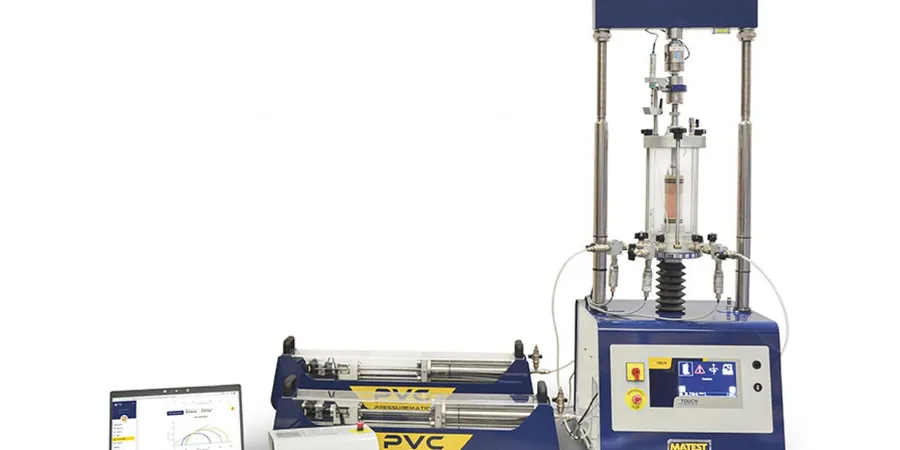
The triaxial test apparatus used in our Auckland laboratory consists of a load frame with a capacity of 50 kN, a cell pressure system capable of maintaining confining stresses up to 1.7 MPa, and automated digital data loggers that record axial strain, deviator stress, and pore pressure at intervals of 0.01 % strain. For projects involving soft compressible clays — common in the reclaimed areas of the Waitematā Harbour — we run consolidated undrained (CU) tests with back-pressure saturation to a B-value of 0.95 or higher, following the procedures of NZS 4402. The equipment can accommodate specimens of 50 mm to 100 mm diameter, and for block samples recovered from deeper strata we perform multi-stage triaxial tests to obtain effective stress parameters from a single sample. When the project involves stiff residual soils from the East Coast Bays Formation, we also combine this with a MASW survey to correlate shear wave velocity with stiffness degradation curves derived from the triaxial test results.
Technical reference image — Auckland
Regional considerations
In Auckland, many engineers overlook the sensitivity of the Puketoka Formation clays — soft, highly plastic materials that lose up to 70 % of their undrained strength once remoulded. If a triaxial test is run on an undisturbed sample without accounting for the sampling disturbance inherent in these sensitive soils, the resulting strength parameters will be optimistic and the foundation design may be unsafe. We address this by measuring sensitivity directly in the triaxial cell: after the first undrained compression, we remould the specimen at the same water content and re-test it. The sensitivity ratio (Su undisturbed / Su remoulded) is then reported alongside the standard parameters, giving the design team a clear warning about post-construction strength loss in case of excavation or earthquake loading.
0.1 % to 2.0 % per minute (UU); 0.01 % to 0.1 % per hour (CU, CD)
Reported parameters
cu, φ′, c′, Eu, E50, pore pressure response
Sample preparation
Undisturbed thin-wall tube / block samples; remoulded for compaction control
Related services
01
Consolidated Undrained (CU) Triaxial with Pore Pressure
The core test for foundation design in the soft clays of the isthmus and harbour edges. We apply back-pressure saturation, measure Skempton B-value, and shear at a rate calibrated to the consolidation coefficient (cv) of the specimen. Results include effective stress strength parameters (c′, φ′) and pore pressure response curves used in slope stability and bearing capacity analysis.
02
Cyclic Triaxial for Liquefaction Assessment
For Auckland's reclaimed waterfront and the loose sand deposits of the Waitematā shoreline, we perform cyclic triaxial tests under stress-controlled conditions at frequencies between 0.1 and 1.0 Hz. The test generates excess pore pressure build-up curves and the number of cycles to initial liquefaction, which is then correlated with the simplified NCEER method (Youd & Idriss 2001) to derive the cyclic resistance ratio (CRR) for site-specific seismic design.
Standards that apply
NZS 4402 (Unconsolidated Undrained Triaxial), NZS 4402 (Consolidated Undrained Triaxial with pore pressure), NZS 4402 (Consolidated Drained Triaxial), NZS 4404:2010 (Geotechnical investigation for land development, references triaxial testing)
FAQ
What is the difference between UU, CU, and CD triaxial tests?
UU (Unconsolidated Undrained) measures total stress undrained strength (cu) without allowing drainage — it simulates short-term loading on saturated clay. CU (Consolidated Undrained) allows the specimen to consolidate under confining pressure before shearing undrained, giving effective stress parameters (c′, φ′) and pore pressure response. CD (Consolidated Drained) is sheared so slowly that any generated pore pressure dissipates — it gives true drained strength (c′d, φ′d) and is used for long-term stability in slow-loading conditions like embankments.
How much does a triaxial test cost in Auckland?
A standard CU triaxial test with pore pressure measurement typically ranges between NZ$ 2,870 and NZ$ 4,970 per specimen, depending on sample preparation complexity, number of consolidation stages, and whether remoulded testing for sensitivity is included. Cyclic triaxial tests cost more due to longer equipment occupancy time. Bulk discounts apply for projects requiring 10 or more specimens.
When should I request a cyclic triaxial instead of a standard CU test?
Cyclic triaxial is required when the design involves earthquake loading — specifically, when assessing liquefaction potential of loose sands or cyclic softening of soft clays. In Auckland, the seismic hazard is moderate but real (Zone Factor Z = 0.13 to 0.20 per NZS 1170.5), so for critical structures like bridges, wharves, or high-rise buildings on the isthmus, cyclic triaxial provides the cyclic resistance ratio (CRR) that a static CU test cannot deliver.
What sample quality is needed for a valid triaxial test?
The sample must be undisturbed — thin-wall tube samples (Shelby tubes) with a diameter of at least 75 mm are preferred. Block samples taken from test pits also work if handled carefully. The sample quality is evaluated by the ratio of the measured shear wave velocity (from bender elements) to the estimated in-situ Vs. Samples with a quality class of A or B (after Lunne et al. 2006) are suitable. Disturbed samples cannot be used for strength determination but can be reconstituted for compaction control tests.
Location and service area
We serve projects across Auckland and surrounding areas.