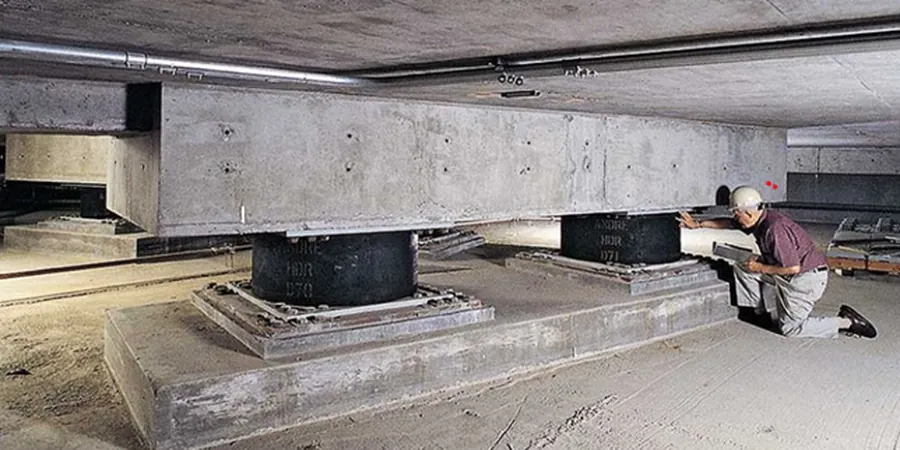
NZS 1170.5:2004 sets the standard for seismic actions in New Zealand, but in Auckland the challenge is less about peak ground acceleration and more about local site effects. The city sits on the Auckland Volcanic Field, with basalt flows, tuff rings, and scoria cones interbedded with soft marine sediments from the Waitemata Group. This layered variability means a one-size-fits-all foundation design rarely works. Our team integrates vs30/" data-interlink="1">shear wave velocity profiling via MASW with borehole data to classify each site per NZS 1170.5 subsoil categories, then tailors the seismic foundation design to the actual stiffness profile. For deeper fills or variable pyroclastic deposits we often combine this with a MASW Vs30 survey to capture the velocity gradient needed for site-specific response spectra.
Auckland's volcanic soils can amplify ground motion by a factor of 2–3 compared to rock sites, making site-specific response analysis essential.
Method and coverage
The equipment we deploy in Auckland reflects the mixed geology. A tracked drill rig with continuous sampling capability handles the hard basalt crusts, while a CPT truck with 20-tonne capacity pushes through the softer alluvial layers of the Waitemata Harbour margins. We run resonant column tests on undisturbed samples from tuff units to measure shear modulus degradation curves at small strains, and triaxial cyclic tests on saturated sands from the isthmus to evaluate liquefaction triggering. The seismic foundation design for each project uses these lab results to set the allowable bearing pressure and to check against the 1-in-500-year earthquake level required by the Auckland Council. This workflow, which includes microtremor HVSR surveys to identify fundamental site frequencies, gives us confidence in the foundation embedment depths and slab thicknesses we recommend.
Technical reference image — Auckland
Regional considerations
Auckland's urban expansion over the last 30 years has pushed development onto the isthmus and former swamplands drained for farming. These soft compressible soils, often peat or estuarine silt several metres thick, present a dual risk: differential settlement under static loads and amplified seismic response during an earthquake. In the 2010–2011 Canterbury sequence, similar soil profiles near Christchurch showed that site amplification was the primary cause of damage, not the fault rupture itself. For Auckland, the volcanic bedrock can trap seismic waves and focus energy into the overlying soft layers. A well-executed seismic foundation design accounts for these site effects by using one-dimensional or two-dimensional ground response analysis, rather than relying on code-mandated amplification factors alone. We have seen projects where ignoring the local soil column would have underestimated the design base shear by 40%.
Class C (shallow soil) to Class E (deep soft soil)
Peak ground acceleration (PGA)
0.13g–0.22g for 500-year return period
Allowable bearing capacity
100–400 kPa after cyclic degradation check
Liquefaction potential index (LPI)
Low to moderate in Holocene sands; high in reclaimed land
Related services
01
Site-specific ground response analysis
Using input motions scaled to Auckland's seismic hazard, we run SHAKE or equivalent linear programs to compute acceleration profiles and response spectra at foundation level.
02
Liquefaction triggering and consequence assessment
SPT-based and CPT-based methods per NZGS Module 1, including cyclic stress ratio versus cyclic resistance ratio, with post-liquefaction settlement estimates for buildings up to 15 storeys.
03
Foundation embedment and slab design
Recommendations for shallow footings, raft slabs, or piles based on bearing capacity, sliding resistance, and allowable differential movement during the design earthquake.
Standards that apply
NZS 1170.5:2004 (Structural design actions – Earthquake actions), NZS 3604:2011 (Timber-framed buildings – seismic foundation provisions), NZGS Module 1: Guideline for the identification and assessment of liquefiable soils (2021), NZS 4402 (Resonant column testing for small-strain shear modulus)
FAQ
What is the difference between site class B and site class E in Auckland?
Site class B corresponds to rock with Vs30 > 760 m/s, typical of the basalt flows in the central volcanic field. Site class E includes soft soils with Vs30 < 180 m/s, found in estuarine areas like the Manukau Harbour margins. The amplification factor for class E can be up to 2.5 times higher, directly increasing the design base shear.
How much does seismic foundation design cost in Auckland?
For a typical residential or small commercial project, the geotechnical investigation and design report ranges between NZ$2,270 and NZ$6,330, depending on the number of boreholes, lab testing, and complexity of the site response analysis. Larger projects with multiple soil units and advanced modeling fall at the higher end.
Do all buildings in Auckland need a site-specific seismic foundation design?
No. Buildings on rock sites (subsoil class A or B) with fewer than 3 storeys and low importance level can follow NZS 3604 prescriptive solutions. However, any structure on soft soil (class D or E), with irregular geometry, or in a liquefaction-prone zone requires a site-specific analysis. The Auckland Council typically requests one for developments over 500 m² footprint.
What laboratory tests are most important for seismic design in Auckland's volcanic soils?
Resonant column and cyclic triaxial tests are critical for measuring shear modulus reduction and damping curves at the strain levels expected during an earthquake. For liquefaction assessment, cyclic direct simple shear tests on intact samples of the target sand layer provide the most reliable cyclic resistance ratio values.
Location and service area
We serve projects across Auckland and surrounding areas.