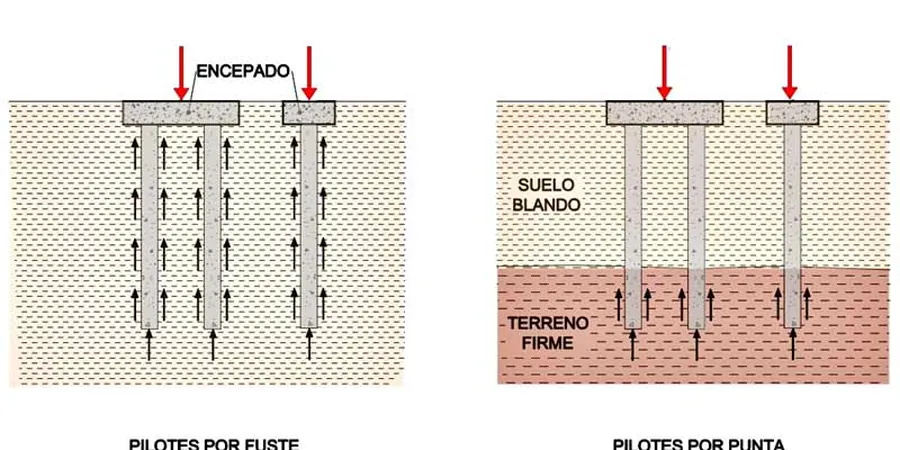
Auckland sits on a patchwork of volcanic basalt, soft marine sediments from the Waitemata Harbour, and alluvial deposits along its isthmus. This diversity means that pile design here isn't a one-size-fits-all calculation. In the central business district, you might hit competent rock within 10 meters, while out near the Manukau Harbour the soil profile could be 30 meters of soft clay and silt. Understanding the balance between pile skin friction and end bearing analysis becomes critical when the ground conditions shift so dramatically across a single site. We model both components separately using measured soil strength parameters from laboratory and field tests, then combine them into a factored design capacity. This approach lets us match the foundation to the actual ground rather than relying on conservative tables.
In Auckland's variable ground, shaft friction can account for less than 10% or more than 80% of total pile capacity depending on location.
Method and coverage
Comparing a site in Ponsonby versus one in Flat Bush shows how different the load-transfer mechanisms can be. On the volcanic slopes of Ponsonby, where residual basalt soils dominate, skin friction along the pile shaft often carries the majority of the load because the weathered rock provides high side resistance. In contrast, the reclaimed peats and soft clays of Flat Bush offer little shaft adhesion, so the pile must rely heavily on end bearing at a deeper competent stratum. We determine these contributions through instrumented static load tests and correlate them with CPT data to refine the capacity of deep foundations for each layer. When soft soils are thick, we might also evaluate settlement under working loads to ensure the pile group behaves as expected. Our field crew logs every meter during boring to capture changes in soil type.
Technical reference image — Auckland
Regional considerations
As Auckland expanded rapidly over the last century, many subdivisions pushed into marginal land: old swamps, filled gullies, and tidal flats. These areas often have soft compressible layers near the surface, with a thin crust over deep clay. If a designer assumes high skin friction based on the crust alone, the pile may settle excessively once the shaft passes into weaker material. The real risk is underestimating the transition zone between friction-dominant and end-bearing-dominant behavior. Our pile skin friction vs. end bearing analysis explicitly accounts for these transitions, so you avoid overdesigning in good ground or underdesigning in poor ground. We've seen projects where ignoring the soft layer beneath a stiff crust led to differential settlements between adjacent columns.
We install strain gauges and telltales along the pile shaft to measure load distribution. This separates shaft friction from end bearing in real time during a maintained load test.
02
CPT-Based Skin Friction Profiles
Using cone penetration testing, we generate continuous profiles of sleeve friction and tip resistance. These are correlated to local Auckland soil types for design parameters.
03
Numerical Load-Transfer Analysis
We run t-z and Q-z analyses using software calibrated against our local database of pile tests. The output gives you settlement versus load curves for each pile.
Standards that apply
NZS 3404:1997 (steel structures, includes pile design), NZS 4203:1992 (general structural design actions, seismic loads), NZGS guidelines for deep foundations (2016), NZS 4402/D1143M (static pile load testing)
FAQ
How does Auckland's volcanic geology affect the friction-to-end-bearing ratio?
Volcanic soils in areas like Mount Eden and One Tree Hill have high shaft friction due to the rough texture of weathered basalt. End bearing may only contribute 20-30% of total capacity there. In contrast, the soft marine clays of the harbour edges give very low friction, so end bearing on deeper rock becomes dominant.
What is the typical cost range for a pile skin friction vs. end bearing analysis in Auckland?
A full analysis including instrumented load testing and numerical modelling typically ranges between NZ$1.690 and NZ$5.170 depending on pile depth, number of test piles, and site access. Smaller projects with just CPT correlation are at the lower end.
Which NZ standard governs the separation of skin friction and end bearing in pile design?
NZS 3404:1997 gives guidance on structural design of piles, while NZGS guidelines for deep foundations (2016) provide the geotechnical framework for determining shaft and base resistance separately. We also reference NZS 4402 for load test procedures.
Can you perform this analysis on existing piles in Auckland?
Yes, we can install retrievable strain gauges on existing piles through coring or attach them to the pile head during a restrike. The analysis then back-calculates the in-situ skin friction and end bearing based on measured strain and displacement.
Location and service area
We serve projects across Auckland and surrounding areas.