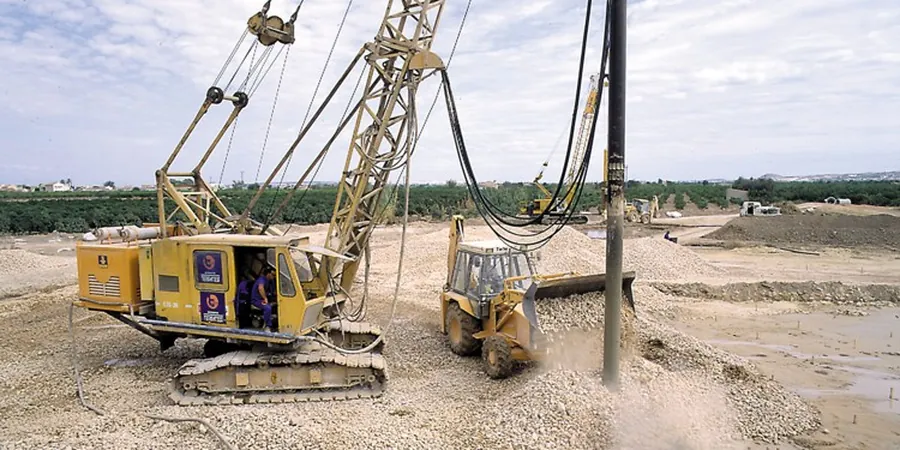
A seven-story apartment complex on Auckland's isthmus recently encountered a familiar local problem: six meters of soft alluvial silt overlying a stiff volcanic tuff. The structural loads demanded a foundation solution that could both improve bearing capacity and accelerate consolidation. Stone column design offered a practical path forward, replacing a costly deep pile scheme. By installing stone columns at 2.2-meter centers, the team achieved a composite ground stiffness that spread loads without overstressing the silt layer. The method also shortened the construction timeline by enabling staged loading directly on the treated ground. For projects like this one, where the subsurface profile varies block by block, working with a laboratory accredited under ISO 17025 ensures the design parameters are reliable from the start.
Stone columns in Auckland's soft soils typically achieve a composite bearing capacity of 250–400 kPa, reducing total settlements by 50–70% compared to untreated ground.
Method and coverage
In Auckland, we frequently see stone columns specified for two distinct scenarios: improving soft marine clays around the waterfront and densifying loose reclaimed fills in former quarry sites like those in the Eden Terrace area. The design process begins with a thorough subsurface investigation — typically combining a CPT investigation to map stratigraphy in continuous profiles with undisturbed sampling for triaxial testing. What many owners overlook is that stone column performance depends heavily on the lateral confinement provided by the surrounding soil. If the native silt has an undrained shear strength below 15 kPa, the columns may bulge rather than densify the ground. That is why we always cross-check the cavity expansion limit using the methods described by Hughes and Withers (1974) before finalizing the column spacing. In fills with gravelly layers, we run plate load tests on trial columns to verify the design assumptions on site.
Technical reference image — Auckland
Regional considerations
Under NZS 4203 and the NZGS guidelines for earthquake geotechnical engineering, stone column design in Auckland must account for the region's moderate seismicity. The primary risk is liquefaction-induced lateral spreading in the saturated silts of the Waitemata Group soils. If the stone columns are not extended through the liquefiable layer into a competent stratum, the entire treated block can displace during shaking. We have seen this issue in reclamation areas near the Viaduct Basin, where older columns stopped short of the underlying sandstone. Our design protocol always includes a Youd-Idriss (2001) liquefaction triggering analysis for the untreated soil and verifies that the stone columns provide sufficient drainage to dissipate excess pore pressures within the duration of strong shaking.
For sites with uniform soft soil profiles, we design columns 0.6–0.8 m in diameter using the Priebe (1978) method. The service includes settlement analysis, spacing optimization, and construction specifications for vibrator or dry-trop compaction methods.
02
Seismic Stone Column Design
When liquefaction mitigation is the primary goal, columns are designed as drainage paths with a spacing tight enough to limit excess pore pressure ratio to 0.5 or less. Output includes post-liquefaction bearing capacity checks and lateral displacement estimates.
What is the difference between stone columns and deep soil mixing?
Stone columns rely on aggregate interlock and confinement from the surrounding soil to carry load, while deep soil mixing mechanically blends cementitious binders with the native soil. Stone columns are generally faster and more cost-effective for Auckland's soft silts, but deep mixing may be preferred when very high column stiffness ( > 50 MPa ) is required or when groundwater chemistry could degrade the aggregate.
How much does stone column design typically cost in Auckland?
For a typical commercial or multi-residential project in Auckland, the design fee ranges between NZ$2,380 and NZ$9,460 depending on the number of column configurations analyzed, the extent of field verification tests required, and whether seismic liquefaction checks are included. The range covers both conceptual and detailed design stages.
Can stone columns be used on Auckland's volcanic slopes?
Yes, but with caution. On slopes steeper than 10 degrees, the lateral confinement provided by the soil decreases, which can lead to bulging failure at the uphill side of the column. We typically recommend a stability analysis using Bishop's simplified method before committing to stone columns on sloping ground. In many cases, a combination of stone columns and a stabilizing berm works well.
What site investigation is required before stone column design?
A minimum of one CPT per 500 m² of site area is standard to map the stratigraphy and identify soft layers. For every three CPTs, we require one borehole with undisturbed sampling for triaxial and consolidation testing. If the site has variable fill, additional trial pits are recommended to check for obstructions that could damage the vibrator.