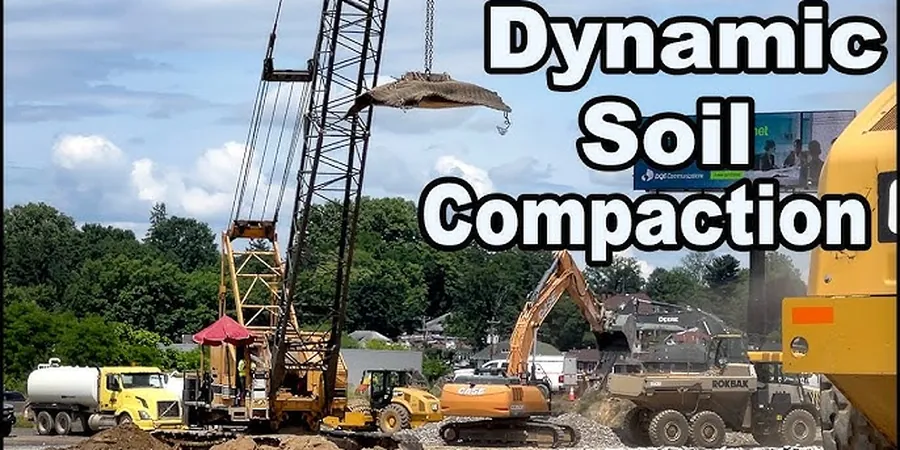
Auckland's growth since the 19th century transformed the isthmus from a sparse colonial outpost into New Zealand's largest urban centre. Much of the city's expansion occurred on reclaimed tidal flats and former swamps around the Waitematā and Manukau harbours. These artificial grounds, combined with layers of volcanic ash from the Auckland Volcanic Field, present a loose, compressible substrate that challenges conventional foundation methods. Dynamic compaction design addresses this legacy by applying high-energy impact to densify granular soils at depth, reducing the risk of excessive settlement in future developments. Before planning a dynamic compaction sequence, our team typically reviews existing borehole logs and in-situ density tests to confirm the target layer — often complementing the assessment with a MASW Vs30 survey for shear-wave velocity profiling across heterogeneous fill zones.
Dynamic compaction design in Auckland must account for buried volcanic rock, variable fill thickness, and a shallow water table that slows drainage between passes.
Method and coverage
The geology beneath central Auckland spans residual clays over Waitematā Group sandstones, Holocene marine deposits along the estuaries, and scoria cones from eruptions like Mount Eden and One Tree Hill. Each unit responds differently to dynamic compaction — sands and gravels densify readily, while cohesive silts require longer rest periods between passes. Our design methodology follows a phased grid pattern: primary passes at 8 m to 12 m spacing, followed by secondary passes at half that spacing to homogenise density. We correlate drop energy (typically 150 to 300 tonne-metres per impact) with target depth using the Menard formula, then verify results with cone penetration tests and post-treatment plate load tests. Parameters we monitor include:
Drop weight — 10 t to 30 t depending on site access
Drop height — 10 m to 25 m for energy control
Grid spacing — primary 10 m, secondary 5 m
Rest period — 7 to 21 days for pore pressure dissipation
Technical reference image — Auckland
Regional considerations
Comparing the volcanic ash soils of Mount Roskill with the hydraulic fill of Wynyard Quarter illustrates Auckland's geotechnical contrast. In Mount Roskill, dynamic compaction encounters stiff residual clays that absorb energy unevenly, risking inadequate densification below 4 m depth. At Wynyard Quarter, loose marine sand with a water table at 2 m requires careful drainage design to avoid liquefaction during compaction. Without a site-specific design, the energy may be too low to reach target layers or too high, causing lateral displacement that damages adjacent services. Our approach integrates groundwater monitoring and vibration control to protect neighbouring structures while achieving the specified relative density.
Field trials using instrumented drops to calibrate energy-to-depth relationships for the local soil profile, adjusting drop weight and spacing to match target density.
02
Pore pressure dissipation analysis
Installation of piezometers in compaction zones to monitor excess pore pressure build-up and define safe rest intervals between passes.
03
Vibration monitoring and control
Continuous recording of peak particle velocity at property boundaries during compaction, ensuring compliance with Auckland Council vibration limits for existing structures.
04
Post-compaction verification testing
CPT, DCP, and plate load testing at crater centres and mid-points to confirm relative density improvement and bearing capacity gains.
This service complements our laboratory testing work for a complete project analysis.
Standards that apply
NZS 4404:2010 — Land development and subdivision infrastructure, NZS 4203:1992 — General structural design and design loadings, NZGS guidelines for Improvement (2020)
FAQ
What is the typical cost of dynamic compaction design in Auckland?
The design and supervision cost for dynamic compaction in Auckland typically ranges between NZ$1,840 and NZ$6,780, depending on site area, required energy levels, and the number of verification tests.
How deep can dynamic compaction improve Auckland soils?
With standard equipment (15 t to 20 t drop weight), improvement reaches 6 m to 10 m. Heavier drops up to 30 t can extend effective depth to 12 m in free-draining sands and gravels.
Does dynamic compaction work on Auckland's volcanic soils?
It works well on scoria, tephra, and pumiceous sands, but residual clays from weathered basalt may require higher energy and longer rest periods. A trial pad is recommended before full-scale application.
What vibration levels are acceptable near existing buildings?
Auckland Council typically adopts the German standard DIN 4150-3, limiting peak particle velocity to 5 mm/s for residential structures and 10 mm/s for commercial buildings during dynamic compaction.
Location and service area
We serve projects across Auckland and surrounding areas.