Many engineering firms in Auckland assume that a standard borehole log provides enough information to characterize seismic site response. That assumption can be costly. The HVSR microtremor survey (Nakamura method) reveals the fundamental resonant frequency of the soil column — a parameter that boreholes alone cannot capture. In a city built on the Auckland Volcanic Field, where stiff basalt caps overlay soft marine sediments, this frequency contrast directly controls how a structure shakes during an earthquake. Without this measurement, a designer may underestimate the amplification that a 10- or 20-story building will experience. The HVSR microtremor survey (Nakamura method) fills that gap quickly, using a single three-component seismometer deployed overnight, and it complements deeper investigations such as MASW vs30 when shear-wave velocity profiles are also needed.
The HVSR microtremor survey (Nakamura method) reveals the fundamental resonant frequency of the soil column — a parameter that boreholes alone cannot capture.
Method and coverage
Auckland’s coastal setting and layered geology create a unique challenge: the soft Holocene clays of the Waitematā Harbour margin can resonate at frequencies as low as 0.5 Hz, while the adjacent volcanic cones produce stiff ground that shifts resonance above 10 Hz. The HVSR microtremor survey (Nakamura method) captures this variability across a site in a single day. The technique measures ambient noise from wind, traffic, and ocean waves, then computes the horizontal-to-vertical spectral ratio. No active source is needed, which makes it ideal for dense urban areas in Auckland where vibration permits are restrictive. The survey outputs include the fundamental frequency f₀ and the corresponding amplitude A₀, which feed into site class definitions per NZS 1170.5. For projects requiring a full seismic profile, the results are often integrated with microzonificación sísmica to map amplification patterns across a district.
Technical reference image — Auckland
Regional considerations
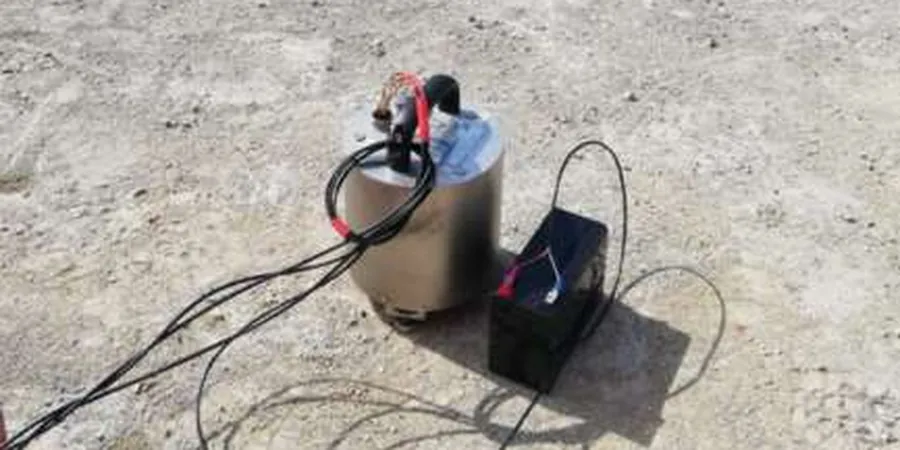
A typical deployment in Auckland involves a portable seismometer roughly the size of a shoebox, placed on a leveled patch of ground and covered with a weatherproof housing. The sensor must be coupled firmly to the soil — on grass, asphalt, or exposed rock — and left to record for at least one hour during low-traffic hours. If the sensor is placed on a filled surface or a vibrating floor slab, the recorded spectrum will be contaminated by anthropogenic noise, leading to a false peak. Another common mistake is positioning the station too close to a retaining wall or a building foundation, which introduces structural resonance into the soil signal. The field crew in Auckland must also account for tidal loading effects near the harbour, which can shift the low-frequency end of the HVSR curve if the recording window is not carefully planned.
Fundamental frequency f₀, amplitude A₀, HVSR curve
Applicable standard
SESAME guidelines (2004) & NZS 1170.5:2004
Related services
01
Single-Station HVSR Survey
Deployment of one broadband seismometer at a key location on your Auckland site. Ideal for small lots or targeted investigation of a known geological boundary. Includes overnight recording, spectral processing, and a one-page summary with f₀ and A₀ values.
02
Multi-Station Array for Site Classification
03
Integrated Seismic Response Report
Standards that apply
NZS 1170.5:2004 – Structural design actions, earthquake actions (site class definition via f₀), SESAME guidelines (2004) – European research project for HVSR acquisition and processing, NZGS Module 3 – Seismic site characterization (MBIE/NZGS guidance)
FAQ
What is the fundamental frequency f₀ and why does it matter for Auckland construction?
The fundamental frequency f₀ is the natural resonant frequency of the soil column above bedrock. In Auckland, soft harbour clays can produce f₀ values below 1 Hz, which matches the natural period of tall buildings (10–20 stories). If the building's period aligns with the soil's f₀, resonance amplifies ground motion by a factor of 2 to 5. The HVSR microtremor survey (Nakamura method) directly measures f₀ so that structural engineers can design the building to avoid this coincidence.
How long does an HVSR microtremor survey take in Auckland?
A single-station survey requires about 2 hours on site: 15 minutes for sensor setup and checking, 60 minutes of continuous recording (preferably after 10 pm to avoid traffic noise), and 30 minutes for retrieval. A multi-station array of 8 stations typically takes two nights of fieldwork. Data processing and reporting add 3 to 5 working days.
How much does an HVSR microtremor survey cost in Auckland?
The cost for a professional HVSR microtremor survey (Nakamura method) in Auckland typically ranges between NZ$2,350 and NZ$4,630 per project, depending on the number of stations, site access conditions, and the level of interpretation required. This range covers single-station surveys up to small multi-station arrays. Larger developments with integrated reporting may fall at the higher end.
What is the difference between HVSR and MASW for seismic site characterization?
HVSR measures the horizontal-to-vertical spectral ratio of ambient noise to identify the fundamental resonant frequency f₀. MASW measures shear-wave velocity (Vs) profiles with depth using surface waves. The two methods are complementary: HVSR gives the frequency where amplification peaks, while MASW gives the stiffness profile that controls that amplification. In Auckland, a combined HVSR + MASW survey provides the most complete site characterization for NZS 1170.5 site class assignment.
Location and service area
We serve projects across Auckland and surrounding areas.