Auckland sits on a complex mix of residual volcanic basalt and soft alluvial clays. The contrast between the Waitematā Harbour foreshore and the volcanic cones like Mount Eden is more than scenic — it defines how grouting design must adapt. In Ponsonby, old fill over basalt requires low-pressure permeation grouting to fill voids without fracturing the rock mass. Near the waterfront at Viaduct Basin, high-water-table alluvium demands chemical grouting for fine sands. Our team has delivered grouting design across both extremes in Auckland, always targeting the specific ground conditions.
Grouting design in Auckland must account for both the basalt's irregular voids and the alluvium's fine particle migration risk — one method does not fit both.
Method and coverage
A recent apartment tower on Albert Street required grouting design to seal a 14 m deep excavation base against artesian pressure. We first ran a permeability field test to map flow paths, then designed a two-phase grouting program: cement-bentonite bulk fill followed by silicate chemical grout for the tight joints in the Waitematā Group sandstone. Key parameters we controlled:
Injection pressure limited to 1.5 x overburden to avoid hydrofracture
W/C ratios starting at 3:1, reducing to 1:1 as refusal approached
Lugeon tests every 5 m to verify permeability reduction below 3 Lugeons
For the volcanic basalt zones further uphill, we switched to a suspension grout with fly ash to reduce bleed and improve penetration into vesicular basalt. The project also benefited from trial compaction grouting in the loose fills of the Britomart area to pre-treat settlement-prone ground before the main grouting design was finalised.
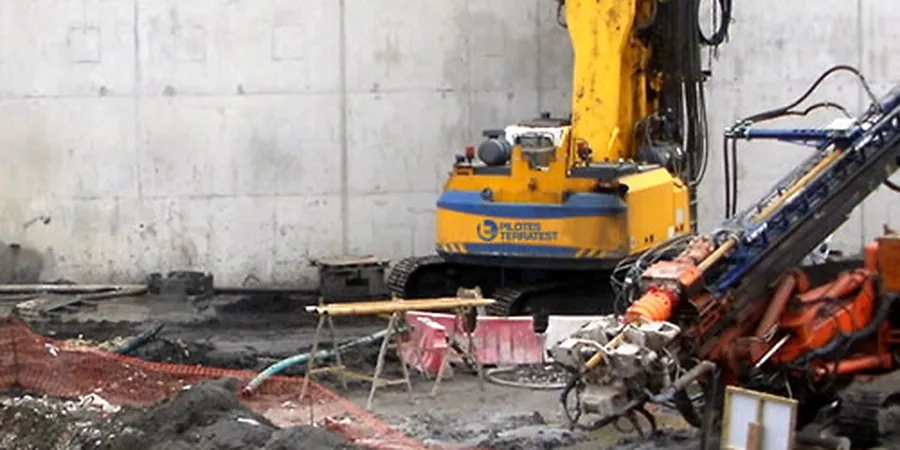
Technical reference image — Auckland
Regional considerations
The most common mistake we see in Auckland is assuming a single grout mix works for all ground. A contractor once pumped a standard cement-bentonite grout into the pumiceous sands of the Tamaki Estuary — the fines washed out before the grout set, leaving voids that later caused surface settlement. Without a grouting design that accounts for the specific particle size distribution and groundwater velocity, you risk either wasting material through excessive bleed or leaving the ground untreated. We always start with a site-specific lab trial using the actual soil and water from the site.
2.0 m / 1.4 m / 1.0 m depending on soil permeability
Lugeon test acceptance criterion
< 3 Lugeons after final injection stage
Bleeding limit for suspension grouts
< 5% after 2 hours (NZS 4402)
Related services
01
Permeation Grouting Design
Low-pressure injection of cement or chemical grouts into sands and gravels to reduce permeability without disturbing the soil structure. Ideal for Auckland's alluvial aquifers and old river channels.
02
Compaction Grouting Design
High-viscosity, low-slump grout injected as a bulb to densify loose fills and collapsible soils. Used in reclaimed land around the Viaduct and Wynyard Quarter.
03
Fracture Grouting (Claquage) Design
Controlled hydraulic fracturing of fine-grained soils to create grout lenses that increase stiffness and reduce compressibility. Applied in soft estuarine clays of the Hobson Bay area.
Standards that apply
NZS 4203:1992 (general structural design actions), NZS 4402 (standard practice for design of groundwater monitoring wells, adapted for grout placement), ASCE Grouting Committee guidelines (2010 edition), FHWA-RD-98-073 (chemical grouting for soil improvement)
FAQ
How much does grouting design cost in Auckland?
For a typical medium-size project (10–30 injection points), our grouting design fee ranges between NZ$2,070 and NZ$6,160, depending on the number of field tests, lab trials, and reporting required. Large projects with multiple phases and monitoring fall at the upper end.
What is the difference between permeation and compaction grouting?
Permeation grouting fills the pore spaces without displacing the soil — it is used to reduce permeability in sands and gravels. Compaction grouting displaces the soil laterally to densify loose fills or collapsing soils. The choice depends on whether you need to seal voids or increase density.
Can grouting design fix settlement under an existing building in Auckland?
Yes, but only if the foundation is accessible and the soil is suitable. Compaction grouting can lift and re-level slabs, while permeation grouting can stabilise loose subgrade. We always need a site investigation first — at least a borehole and a plate load test — to verify the grout will reach the target zone without damaging the structure.
How long does a grouting design project take from start to finish?
The design phase alone takes 1–3 weeks, including lab work and numerical modelling. Field grouting operations can take 2–8 weeks depending on the number of injection points and the ground conditions. We always allow extra time for Lugeon testing between stages.