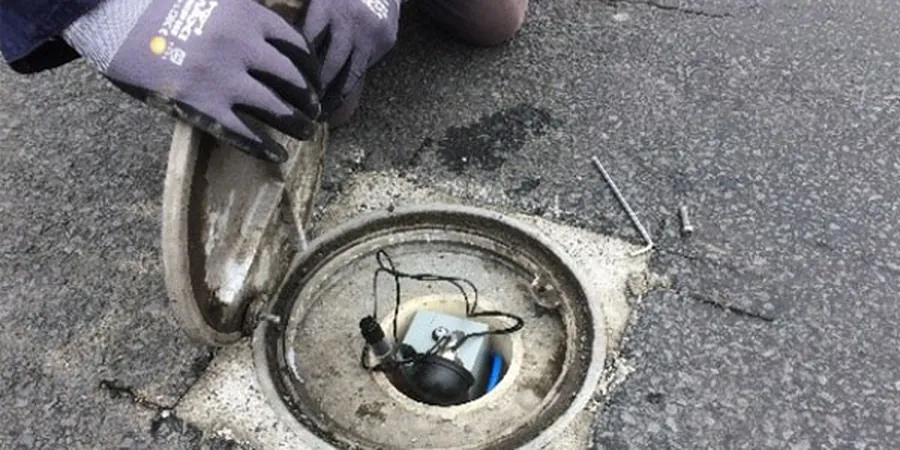
Auckland's volcanic geology and soft alluvial deposits make it one of New Zealand's most challenging cities for subsurface monitoring. We design and install geotechnical instrumentation systems that track pore pressures, ground movement, and deformation in real time. Before finalizing the instrument layout, we often run a MASW vs30 survey to establish the shear wave velocity profile, which helps calibrate the response of deep inclinometers. Every system is tailored to Auckland's specific soil conditions, from the Waitemata Group sandstone to the volcanic tephra layers found in the central isthmus.
Real-time data from inclinometers and piezometers reduces construction risk in Auckland's variable ground by allowing engineers to respond before movement becomes critical.
Method and coverage
The difference between monitoring a site in Ponsonby versus one in Mangere is stark. Ponsonby sits on firm East Coast Bays formation rock, while Mangere is underlain by soft, saturated volcanic ash and peat. For the softer ground we install arrays of pneumatic piezometers and settlement plates; for the harder rock we rely on rod extensometers and tiltmeters. This contrast means the geotechnical instrumentation design must adapt to local stratigraphy. We also use in-place inclinometers where continuous lateral movement profiles are needed, particularly along retaining walls or near deep excavations in the CBD.
Technical reference image — Auckland
Regional considerations
Auckland's rapid urban expansion over the last two decades has pushed development onto reclaimed land and former swamps. These areas, like the Wynyard Quarter and parts of Hobsonville, have high groundwater tables and compressible soils. Without proper geotechnical instrumentation, differential settlement and slope instability go undetected until structural damage appears. We install automated alarm systems that trigger when pore pressure exceeds thresholds, giving contractors time to adjust dewatering rates or add temporary support. Early warning is the difference between a controlled intervention and a costly remediation.
Vibrating wire and standpipe piezometers installed in boreholes to monitor groundwater pressure changes during excavation or dewatering. We use hydraulic packers for multi-level readings in a single hole.
02
Inclinometer and Tiltmeter Systems
Manual or automated inclinometers for lateral movement monitoring of retaining walls, deep excavations, and embankments. Tiltmeters are surface-mounted on structures to detect rotation.
03
Settlement and Heave Monitoring
Settlement plates, rod extensometers, and liquid level systems to track vertical displacement. Ideal for monitoring fill placement, tunnel construction, or foundation loading in soft ground.
04
Data Logging and Telemetry
Battery-powered dataloggers with cellular or LoRaWAN transmission for remote sites. Data is uploaded to a secure portal with configurable alarm thresholds and automated email alerts.
This service complements our laboratory testing work for a complete project analysis.
Standards that apply
NZS 3404:1997 (Steel structures — inclinometer casing connections), NZS 4203:1992 (General structural design and design loadings for instrumentation), NZGS 2016 (Guideline for Geotechnical Observation and Instrumentation), NZS 4402 (Standard Test Method for Monitoring Ground Movement Using Inclinometers)
FAQ
What geotechnical instruments are most commonly used in Auckland's volcanic soils?
Vibrating wire piezometers and inclinometers are the most common. The volcanic tephra and ash layers in Auckland have high permeability contrasts, so multi-level piezometers are installed to capture pore pressure at different depths. Inclinometers track lateral movement in the softest layers.
How long does it take to design and install a geotechnical instrumentation system?
For a typical urban site, design takes 1–2 weeks and installation 2–5 days depending on the number of boreholes and sensor types. We mobilize a crew with a track-mounted drill rig and a technician for sensor calibration on-site.
What is the typical cost range for geotechnical instrumentation in Auckland?
A basic system with three vibrating wire piezometers and two inclinometers ranges from NZ$3,890 to NZ$6,170. This includes drilling, sensor installation, initial data logging setup, and a baseline report. Larger arrays or automated telemetry add to the cost.
Do you provide real-time data access for the client?
Yes. We set up a web-based dashboard where you can view live readings, download CSV exports, and set up SMS or email alerts when thresholds are exceeded. The platform is compatible with most construction management software.