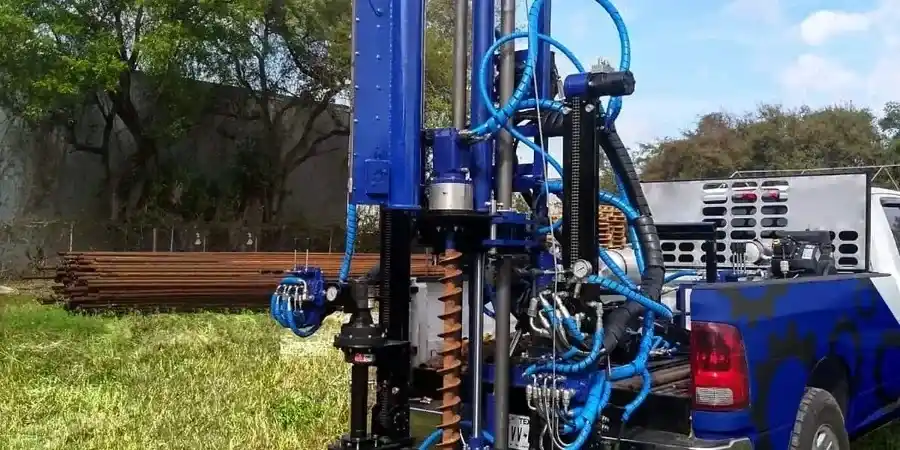
Auckland's volcanic geology and coastal sediments create highly variable ground conditions. Between the Waitematā Harbour and the Manukau Harbour, layers of soft marine clays, pumice-rich sands, and basalt flows alternate unpredictably. That is why the Standard Penetration Test remains our primary field tool for profiling strength and density in this city. We deploy it across residential subdivisions in Albany and commercial sites in the CBD, always following AS/NZS 1289.6.3.1. A 63.5 kg hammer drops 760 mm, driving a split-spoon sampler 450 mm into the borehole base. The blow count per 300 mm penetration gives the N-value. This number feeds directly into bearing capacity estimates, liquefaction screening, and settlement analysis. For deep foundations we also cross-check results with pilotes hincados to validate pile drivability in Auckland's heterogeneous subsoil.
In Auckland's variable volcanic soils, a single SPT profile can reveal N-values ranging from 5 in ash layers to over 50 in basalt boulders.
Method and coverage
Many local engineers assume SPT is just a quick field check. It is not. We log each test in strict compliance with NZS 4203 loadings and NZGS field guidelines. The split-spoon sampler retrieves disturbed material for classification, but the real value lies in the blow-count profile. In Auckland's eastern suburbs, where residual soils from Waitemata Group sandstone dominate, N-values can jump from 8 to 45 within two metres. We record refusal criteria — 50 blows for any one increment — and note rod friction corrections. The method also allows us to retrieve groundwater samples and perform visual classification on site. When dealing with soft estuarine deposits near the Viaduct Basin, we supplement SPT with masw-vs30 to obtain shear-wave velocity profiles for dynamic analysis. That combination gives a complete picture for seismic design.
Technical reference image — Auckland
Regional considerations
The tripod and safety hammer weigh over 200 kg. On Auckland's narrow residential lots, we must plan access carefully to avoid damaging underground services. Each test generates a borehole that needs proper backfill — bentonite-cement grout is mandatory to prevent artesian flow paths. The main risk is misinterpretation: in pumiceous sands, N-values can underestimate relative density because particles crush under the hammer. We flag this in our logs and recommend complementary sampling. For deep basements in the CBD, we also monitor borehole stability with casing and drilling mud to avoid sidewall collapse in loose fills.
Blows per 150 mm interval; N = blows for last 300 mm
Maximum blows
50 blows per increment (refusal)
Correction factor (CN)
Pa/σ'v0 for overburden normalization (N1,60)
Related services
01
Borehole SPT with continuous sampling
Standard 50 mm boreholes advanced with solid-stem auger or wash boring. SPT at 1.5 m intervals or at every change of stratum. Disturbed samples bagged and transported to our lab for classification and moisture content.
02
SPT-based liquefaction assessment
Using the Youd-Idriss (2001) method with N1,60-cs values. We apply fines correction and calculate factor of safety against triggering. Reports include cyclic resistance ratio (CRR) and cyclic stress ratio (CSR) profiles for Auckland's seismic hazard.
03
High-resolution SPT for deep foundations
Continuous 1.0 m interval testing to refusal depth. Data used to design driven piles and drilled shafts. We correlate N-values with CPT resistance and lab shear strength for site-specific pile capacity curves.
Standards that apply
AS/NZS 1289.6.3.1: Standard Test Method for Standard Penetration Test, NZS 4203: General structural design and design loadings, NZGS 2001: Field description of soil and rock — guidelines
FAQ
What N-value indicates competent bearing strata in Auckland soils?
For most Auckland sites, N-values above 30 in sands or above 15 in clays suggest adequate bearing for shallow foundations. In basalt deposits, N-values often exceed 50 — but drilling refusal may require alternative methods. We always cross-check with lab tests on undisturbed samples.
How does the SPT account for groundwater in Auckland's coastal areas?
We record water levels during drilling and again after 24 hours in the borehole. For sites near the Waitematā Harbour or the Kaipara Harbour, artesian conditions may require casing. Corrections for effective stress are applied to N-values using the overburden correction factor CN. This is critical for liquefaction analysis.
What is the difference between corrected and uncorrected N-values?
The raw N-value is the blow count recorded in the field. Corrected N-values (N1,60) account for overburden stress, rod energy ratio, borehole diameter, and sampler type. For Auckland's deep alluvial deposits, corrections can increase or decrease the value by up to 30%. Our reports always present both raw and corrected values.
Can SPT be performed in very soft clays without disturbing the sample?
In soft clays (N < 4), the SPT hammer impact can remould the soil and give unrepresentative strength. For these conditions, we recommend a shear vane test or a thin-walled tube sampler. We still run the SPT for stratigraphic profiling, but the N-value is not reliable for strength estimation. We flag this in the log.
Location and service area
We serve projects across Auckland and surrounding areas.