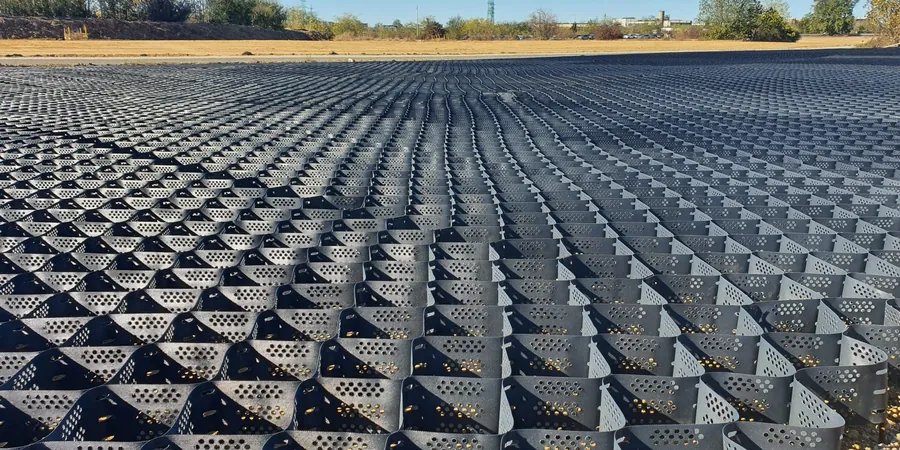
In Auckland we often see projects stalled by the city’s complex geology — soft volcanic ash over Waitemata sandstone, or deep peat in the isthmus. Geocell design offers a practical way to stabilise these weak layers without importing expensive fill. The three-dimensional cellular confinement locks granular material in place, spreading loads and preventing lateral movement. Before finalising the geocell layout, it’s common to run a resistivity survey to map subsurface variability, especially in areas like Pukekohe where old volcanic cones create unpredictable soil profiles. That data directly informs cell depth and infill selection.
Geocell design in Auckland reduces fill thickness by up to 40% compared to unreinforced granular bases, cutting haulage costs on soft ground.
Method and coverage
Comparing the North Shore’s firm Waitemata sandstone with South Auckland’s soft alluvial clays shows why geocell design must be site-specific. On the Shore, a shallow geocell layer can handle light traffic loads. In Manukau Harbour margins, the same design would fail without deeper excavation and stiffer infill. We combine geocell analysis with a pavement subgrade assessment to determine the exact confining stress required. Key parameters we evaluate:
Cell height (typically 75–200 mm depending on load)
Weld spacing (yielding aperture shape)
Infill aggregate angularity and gradation
Subgrade CBR and moisture sensitivity
Every Auckland project gets a custom cell layout, not a one-size-fits-all chart.
Technical reference image — Auckland
Regional considerations
The New Zealand Geotechnical Society guidelines emphasise that geocell design must account for Auckland’s high water table and expansive clay layers. If the confinement is insufficient, the cells bulge and the pavement fails by rutting. In areas like the Kaipara Harbour basin, seasonal moisture swings reduce subgrade stiffness dramatically. We model worst-case saturation using unsaturated soil mechanics to set a safe factor of safety above 1.5. That extra margin prevents costly repairs during Auckland’s wet winters.
Steep cuts in the volcanic ring plain benefit from geocell confinement that prevents surficial sliding. We dimension cell height and anchor length using limit equilibrium analysis.
02
Load-support platforms
For access roads over peat or soft clay, geocell design reduces total fill thickness. We calculate the stress distribution angle and verify bearing capacity with plate load tests.
03
Retaining wall facing panels
Geocells filled with on-site soil form a vegetated facing for MSE walls. In Auckland’s residential subdivisions, this avoids the cost of imported rock facing while meeting Council erosion control standards.
Standards that apply
NZS 4404:2010 – Land development and subdivision infrastructure, NZS 3404:1997 – Steel structures (for connection design), FHWA-HRT-10-070 – Geosynthetic reinforcement of flexible pavements, NZS 4402 – Standard test method for accelerated tensile creep
FAQ
How much does geocell design cost for a typical Auckland access road?
For a standard 200 m² access road over soft ground, geocell design and supply typically ranges between NZ$1.600 and NZ$3.630 depending on cell height, infill material, and site access. We recommend a site visit to confirm the exact scope.
What is the difference between geocell and geogrid for pavement reinforcement?
Geocells provide 3D confinement that prevents lateral spreading of the aggregate, while geogrids offer planar tensile reinforcement. In Auckland’s soft subgrades, geocell design is usually more effective for reducing rutting because it locks the material in all directions.
Can geocell design be used on slopes steeper than 45 degrees?
Yes, but only with proper anchorage at the crest and intermediate pins. In Auckland’s volcanic tuff slopes, we install a drainage layer behind the cells to prevent hydrostatic pressure build-up. Without drainage, the cells can bulge even on moderate slopes.
Location and service area
We serve projects across Auckland and surrounding areas.