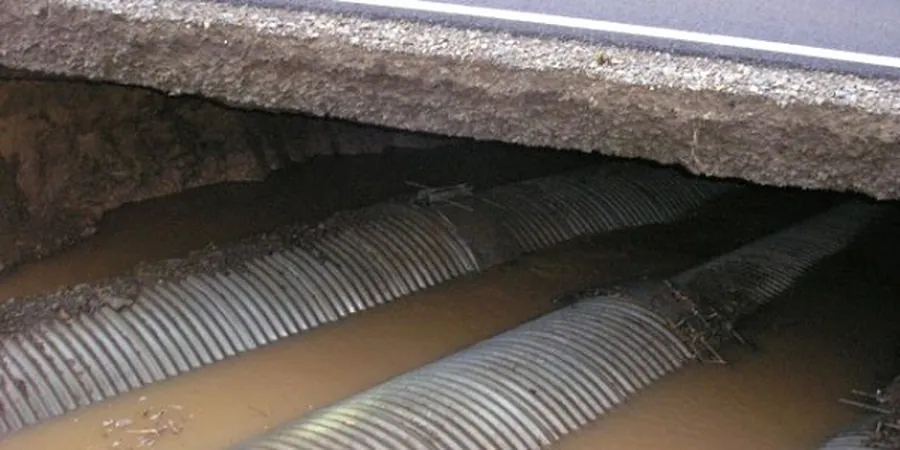
Many construction teams in Auckland assume that any gravel layer under the road base will drain adequately. That assumption fails on the volcanic ash and residual clay soils across the isthmus. Water gets trapped between low-permeability layers, and the subgrade loses strength within months. A proper geotechnical road drainage design must start with field data. We measure the actual hydraulic conductivity before specifying subdrains or edge drains. Skipping this step leads to premature pavement failure and costly rebuilds. The local geology demands a site-specific approach, not a generic cross-section from a manual.
Ignoring the perched water table in Auckland's volcanic ash can reduce subgrade CBR by 60% within a single winter season.
Method and coverage
Auckland expanded rapidly over the past two decades, pushing roads onto former swamps and steep basalt ridges. Those terrains behave nothing like the stable alluvial flats of the central city. The volcanic soils contain layers of tephra and pumice that shift under repeated wetting. That is why our geotechnical road drainage solutions always include a field permeability test to locate the true water table. We also run infiltration tests at multiple depths to map preferential flow paths. The result is a drainage system that matches the ground, not the textbook.
Technical reference image — Auckland
Regional considerations
A subdivision access road in Pukekohe was built last year with a standard 200 mm subdrain on one side only. By mid-winter the pavement was pumping fines through the joints. The perched water table sat just 400 mm below formation level. We investigated and found the drainage layer had clogged with silt from the adjacent volcanic loam. The fix required full-depth reclamation and a new geocomposite drain system. That job cost three times what a proper geotechnical road drainage study would have added upfront. Water does not wait for the contractor to finish.
We design subdrain networks, collector pipes, and filtration layers based on measured permeability and groundwater levels. The system integrates with existing stormwater outfalls and avoids interference with shallow utility corridors. We specify geotextile separation layers to prevent migration of fines into the aggregate.
02
Field Permeability Testing
Constant-head and falling-head tests are conducted in boreholes and test pits to determine in-situ hydraulic conductivity. The results are mapped to define drainage zones across the alignment. We then recommend the optimal depth and spacing of lateral drains for each soil type encountered.
Standards that apply
NZGS 2005: Field Measurement of Permeability, NZTA M22: Specification for Road Drainage, NZS 4402: Field Infiltration Test in Unsaturated Soils
FAQ
How much does a geotechnical road drainage study in Auckland cost?
The cost typically ranges between NZ$1.490 and NZ$4.640 depending on site access, number of test locations, and the complexity of groundwater conditions. This includes field permeability testing, analysis, and a design report.
What is the difference between a subdrain and a French drain in road applications?
A subdrain is a perforated pipe surrounded by clean aggregate and wrapped in a filter fabric, designed to collect and convey groundwater. A French drain is a gravel-filled trench without a pipe, relying on the aggregate void space for flow. For Auckland road projects, subdrains are preferred because they provide a positive outlet and can be cleaned or inspected. French drains are only used in low-traffic areas where maintenance access is not feasible.
When should a geocomposite drain be used instead of a traditional aggregate layer?
Geocomposite drains are used where vertical space is limited, such as under thin pavements or adjacent to retaining walls. They consist of a drainage core wrapped in geotextile and are much thinner than a gravel blanket. In Auckland's volcanic soils, they reduce the risk of clogging by fines compared to open-graded aggregate. They are also faster to install and reduce the import of clean stone.