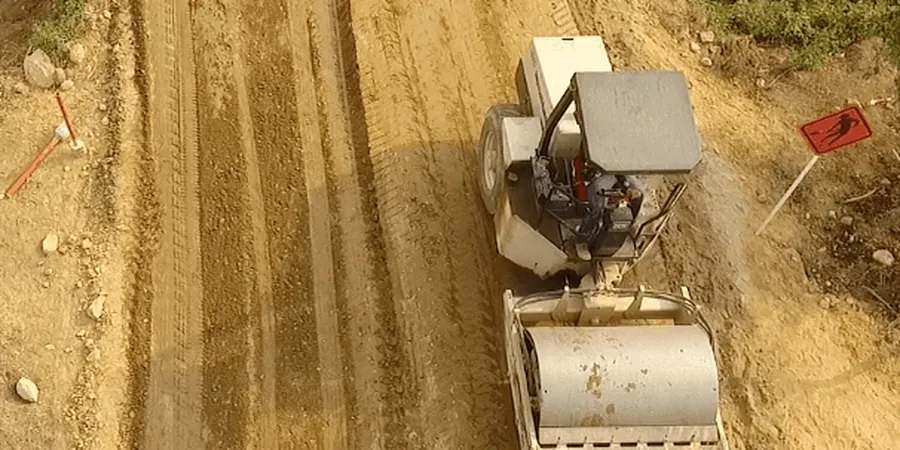
Auckland grew fast in the 20th century, sprawling over volcanic cones and former swamplands. The underlying geology mixes Waitemata Group sandstone and siltstone with pockets of soft alluvium and stiff residual clays. That variety creates real challenges when you need a uniform subgrade. In our experience, lime and cement stabilization is the most reliable method to turn problematic soils into a consistent platform. It works by altering the clay mineral structure, reducing plasticity and swelling potential while raising California Bearing Ratio values. We typically apply it before placing structural fill or pavement layers, often combined with a laboratory compaction test to determine the optimum moisture and binder dosage for each specific lot.
Auckland's volcanic clays can swell up to 10% in volume after rainfall. Lime treatment cuts that expansion to under 1% within a week of mixing.
Method and coverage
NZS 4404:2010 sets the framework for earthworks in Auckland, but stabilization design follows the NZGS field classification and the modified lime-cement guidelines from Transit NZ. The key is matching binder type to soil chemistry. For the high-plasticity clays common in the central isthmus, quicklime works faster than hydrated lime because the exothermic reaction drives off moisture. For silty soils near the Manukau Harbour, cement gives better short-term strength gain. We always run a pH test on-site at 24 hours to confirm that enough lime remains active for the pozzolanic reaction to continue. A full geotechnical investigation before mixing tells us the natural moisture content, Atterberg limits, and sulfate levels, which can interfere with cement hydration if present above 0.3%.
Technical reference image — Auckland
Regional considerations
In Auckland, many times we see contractors skip the preliminary mellowing period and try to compact lime-treated clay immediately. That traps moisture and creates a sponge that never gains full strength. Another common issue is uneven binder distribution from worn-out mixing rotors, leaving pockets of untreated soil that soften during winter rains. The result is differential settlement under pavement or slab-on-grade. We also watch for sulfates in the groundwater around the old landfill sites near the waterfront — if the concentration exceeds 0.3%, cement can form expansive ettringite crystals that break the stabilized layer from within. A simple sulfate test before starting avoids that hidden failure.
Application of quicklime or hydrated lime to reduce plasticity index and swelling potential. Includes on-site pH monitoring, moisture control during mellowing, and compaction testing to NZS 4404 standards. Suitable for subgrades and capping layers where long-term volume change must be minimized.
02
Cement Stabilization for Subgrades and Pavements
Portland cement mixed at 3%–8% by dry weight to achieve rapid strength gain. We perform unconfined compression tests after 3 and 7 days of curing, plus soaked CBR to verify pavement design values. Ideal for road bases, industrial slabs, and areas where traffic needs to run within a week.
Standards that apply
NZS 4404:2010 Land development and subdivision engineering, NZGS Field Description of Soil and Rock (2005), Transit NZ P/11 Specification for Lime Stabilisation, NZS 4402 Standard Test Method for Using pH to Estimate the Soil-Lime Proportion Requirement
FAQ
How long does it take for lime-stabilized soil to gain full strength in Auckland's climate?
With proper mellowing and compaction, lime-treated clay reaches about 70% of its long-term strength in 7 days. Full pozzolanic curing takes 28 days under normal Auckland temperatures. Wet winters slow the reaction, so we recommend scheduling stabilization during spring or summer when the average high is above 18°C.
What is the cost range for lime and cement stabilization in Auckland?
For a typical road subgrade or building platform, the cost ranges between NZ$1,260 and NZ$4,220 per site, depending on the area treated, binder dosage, and access conditions. This includes material supply, mixing, compaction, and QA testing. Large subdivisions fall toward the lower end per square metre.
Can cement stabilization be used on soils with high organic content?
Not reliably. Organic matter above 2% by weight interferes with cement hydration and can prevent any strength gain. For peat or topsoil pockets common in the Auckland region, we either excavate and replace or switch to lime stabilization, which reacts with the clay fraction even when organics are present.
What tests confirm that the stabilization worked correctly?
We run a pH check at 1 hour (target ≥12.4 for lime), unconfined compressive strength on undisturbed tube samples at 7 days, and soaked CBR at 28 days. If the project requires it, we also measure the linear shrinkage after treatment. All results are compared to the design values established during the initial laboratory mix design.