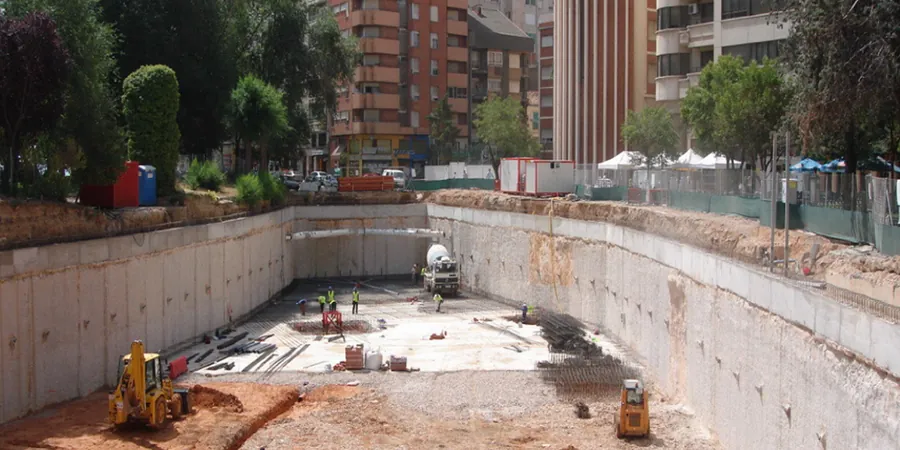
Auckland sits on the Auckland Volcanic Field, with basalt flows and tuff deposits interbedded with soft marine clays and Waitemata Group sandstones. This layered geology means diaphragm walls must cut through variable stiffness layers while controlling groundwater inflow. The city's high water table near the Waitemata Harbour demands walls that double as cut-off barriers. We design each panel to resist lateral earth pressures from the soft estuarine soils and the stiff volcanic breccias that dominate the central isthmus. Before finalizing the panel geometry, we often run a resistivity survey (SEV) to map the basalt interface, ensuring the trenching equipment can handle the transition between hard rock and soft clay.
Diaphragm walls in Auckland must cut through basalt flows and soft marine clays while controlling groundwater inflow from the Waitemata Harbour.
Method and coverage
Auckland's rapid urban intensification since the 1990s pushed diaphragm wall use into high-rise basements along Queen Street and the Viaduct Basin. We design walls that serve dual functions: retaining excavation sides and forming the final basement perimeter. Key parameters include panel width (600-1200 mm), concrete strength (32-50 MPa), and steel cage reinforcement designed per NZS 3101. For deep excavations exceeding 15 m, we incorporate the instrumentation and monitoring of wall deflection using inclinometers. Construction sequence matters: we specify bentonite or polymer slurry support, tremie concrete placement, and hydrophone testing of joints between panels. Our designs reference the NZGS Module 1 guidelines for earth retention, adapting to the specific Auckland stratigraphy.
Technical reference image — Auckland
Regional considerations
A 15-story building on Albert Street required a 22 m deep diaphragm wall. The excavation encountered a buried basalt flow that slowed trenching by 40%. Without a pre-tender geophysical survey, the contractor would have faced cost overruns. We mitigated this by designing a two-stage excavation: pre-drill the basalt zones with a rock grab, then complete the panel. The wall also had to resist hydrostatic pressure from a perched aquifer within the tuff layer. We specified a 1.0 MPa/m grout curtain at the base to cut off seepage.
Full wall design including panel layout, reinforcement schedules, and stability analysis against basal heave and piping. We incorporate in-situ data from SPT and CPT to calibrate soil stiffness for wall deflection modeling.
02
Construction Support & Monitoring
On-site supervision of trench excavation, slurry quality control, and concrete placement. We supply inclinometer and piezometer data to verify wall performance during basement excavation.
This service complements our laboratory testing work for a complete project analysis.
What is the typical cost range for diaphragm wall design in Auckland?
For a standard city-center basement with walls up to 20 m deep, design fees range between NZ$2,900 and NZ$13,100 depending on panel count and soil variability. This includes geotechnical interpretation, structural calculations, and construction drawings.
How does Auckland's volcanic geology affect diaphragm wall construction?
The basalt scoria and tuff layers are abrasive and can slow trenching. We design for rock grab excavation in these zones, and specify polymer slurry instead of bentonite to reduce clogging in the sand-gravel lenses common in the Waitemata Group.
What is the maximum depth achievable for diaphragm walls in Auckland?
Depths of 25-30 m are feasible in the CBD where the underlying Waitemata sandstone provides a competent bearing stratum. Deeper walls require careful assessment of panel stability and groundwater control, especially near the waterfront.
Location and service area
We serve projects across Auckland and surrounding areas.