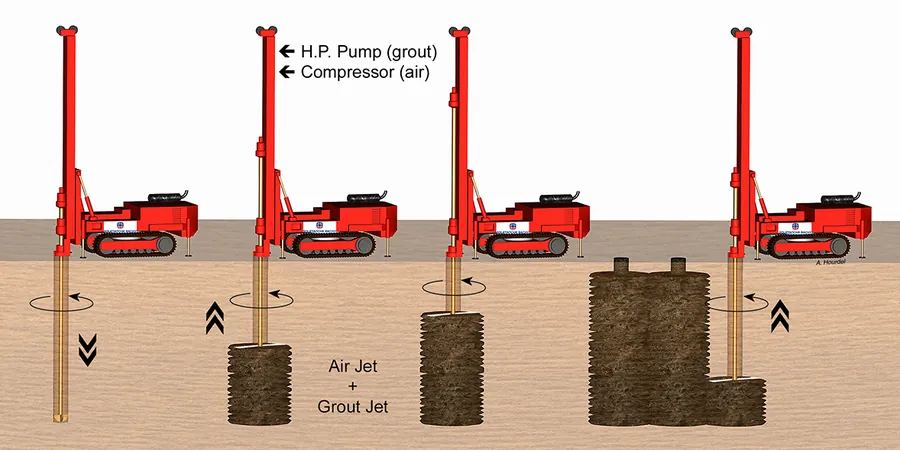
Auckland's humid subtropical climate and its position on the active Hauraki Rift mean that most construction sites encounter saturated volcanic ash, pumiceous sands, and soft Waitemata Group mudstone at shallow depth. The water table sits just a few metres below grade in many coastal suburbs, so any Improvement method must handle high pore pressures without remoulding the soil mass. In our experience, jet grouting design becomes the most reliable technique when you need to treat a discrete zone of poor ground without excavating or dewatering. We have designed and supervised jet grouting patterns for basements, tunnel portals, and bridge abutments where traditional piling could not guarantee continuity through the heterogeneous Auckland soils.
We validate predicted column diameters with full-scale trials at the site, correlating jetting parameters against in-situ density and fines content.
Method and coverage
Our jet grouting design methodology follows EN 12716:2018 and the NZGS Guideline for Improvement, adapted specifically to Auckland's variable stratigraphy. We start with a detailed 3D ground model built from borehole logs, CPTu soundings, and — where lateral variability is high — cross-hole tomography. The key parameters we control are the grout mix water-to-cement ratio, the rotation and withdrawal speed of the monitor, and the energy delivered per metre of column. For Auckland's pumice-rich layers we often increase the specific energy by 15-20% to achieve the target unconfined compressive strength. Before finalising a design we always correlate the jetting parameters with the in-situ density and fines content of each stratum, and we validate the predicted column diameter with a full-scale trial at the site. This methodical approach, combined with monitoreo de excavaciones to track ground response during jetting, has proved effective in over forty projects across the isthmus.
Technical reference image — Auckland
Regional considerations
The biggest risk we see in Auckland is the presence of isolated pumice lenses and organic layers within the East Coast Bays Formation. These zones can absorb grout energy unpredictably, leaving gaps in the column array if the design does not account for their variable stiffness. Another concern is the high lateral permeability of the volcanic tuff horizons — if the grout returns escape into the surrounding ground, the column may not reach its full diameter. That is why we always install pressure transducers in observation holes during the first production columns and adjust the withdrawal speed on the fly. A secondary issue is the potential for hydrofracture of the overlying clay crust when jetting under the water table; we mitigate this by reducing the lift rate in the upper 2 metres of the column.
For columns up to 1.2 m diameter in cohesive soils we apply the single-fluid system, using a cement-bentonite grout at moderate pressure (35–45 MPa). Where the target diameter exceeds 1.5 m or where gravel lenses are present we switch to the double-fluid method, which adds a coaxial air jet to erode the soil more effectively. We specify the nozzle geometry, rod rotation speed (typically 10–20 rpm), and lift rate (25–50 cm/min) based on the site-specific SPT N-values and plasticity index.
02
Triple-fluid jet grouting design for very soft marine clays
In Auckland's harbour-edge reclamation areas, where the upper 8–10 m consists of soft to very soft clay (undrained shear strength below 20 kPa), we use the triple-fluid system. Water and air jets cut the soil while a separate grout nozzle fills the cavity from below, minimising mixing with the in-situ clay. We design the column layout as a secant wall for cofferdams or as a bottom plug for excavations, and we always verify the effectiveness with core drilling and pressuremeter tests after curing.
This service complements our laboratory testing work for a complete project analysis.
Standards that apply
EN 12716:2018 – Execution of special geotechnical works: Jet grouting, NZGS Guideline for Improvement (2019), NZS 3404:1997 (incorporating Amendment 1) – Steel structures standard (design of structural elements retaining jet-grouted blocks)
FAQ
How much does jet grouting design cost in Auckland?
The design fee for a typical jet grouting scheme in Auckland ranges from NZ$2,660 to NZ$9,620, depending on the number of ground models required, the complexity of the column layout, and whether a full-scale field trial is included. This range covers the site-specific parameter selection, numerical analysis of column interaction, and the preparation of construction drawings and specifications.
What is the maximum column depth achievable with jet grouting in Auckland's soils?
We have designed jet grout columns reaching 22 m below ground level in the volcanic tuff sequences of central Auckland. In the softer marine clays of the Viaduct Basin and Wynyard Quarter, the practical limit is around 18 m due to the risk of column deviation and the difficulty of maintaining a consistent grout return. For deeper treatment we usually recommend a hybrid solution combining jet grouting with driven piles.
How long does a jet grouting design study take from site data to ready-to-tender documents?
For a straightforward basement retention scheme with 40 to 80 columns, we typically deliver the full design package — including ground model, parameter selection, column layout plan, and execution specifications — in 12 to 15 working days after receiving the geotechnical investigation report. If a field trial is required, add 8 to 10 days for the trial execution, coring, and strength testing.
Can jet grouting design be used for liquefaction mitigation in Auckland?
Yes, we have designed jet grout panels specifically for liquefaction mitigation in the volcanic ash deposits of the Auckland isthmus. The method works well because the treated columns increase the overall stiffness of the soil mass and reduce cyclic shear strains in the untreated pockets between columns. The design must follow the NCEER-based guidelines for untreated soil spacing, which in Auckland typically results in a column centre-to-centre distance of 2.2 to 2.8 m for a 1.0 m diameter column.
Location and service area
We serve projects across Auckland and surrounding areas.