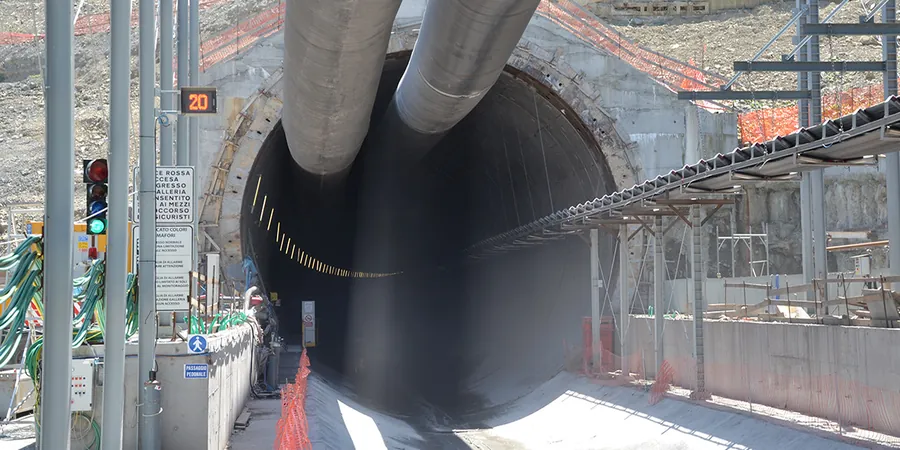
Many construction teams in Auckland assume that tunnel design in volcanic soft ground can follow conventional rock tunneling parameters. That assumption often leads to underestimated face pressures and unexpected surface settlements. The city's unique geology, dominated by the Waitemata Group sandstones and silts interbedded with Tauranga Group clays, requires a dedicated geotechnical analysis for soft soil tunnels. Without site-specific data on shear strength and stiffness, the risk of instability during excavation rises sharply. A thorough analysis identifies the precise soil layering and groundwater conditions that control tunnel behavior.
In Auckland's soft ground, a 10 percent error in undrained shear strength can double predicted tunnel face extrusion and trigger sinkholes.
Method and coverage
Auckland sits on the Auckland Volcanic Field with more than 50 eruption centers, and much of the shallow subsurface consists of soft alluvial clays and pyroclastic deposits up to 40 meters thick. For tunnel alignments crossing these deposits, the geotechnical analysis for soft soil tunnels must address three critical parameters: undrained shear strength, modulus of elasticity, and coefficient of lateral earth pressure. We combine cone penetration testing with laboratory triaxial tests on undisturbed samples to obtain reliable profiles. Before reaching the tunnel horizon, the team often runs a MASW survey to map stiffness contrasts, and then validates those results with instrumented boreholes for continuous settlement monitoring during construction.
Technical reference image — Auckland
Regional considerations
Under NZGS guidelines and the requirements of NZS 4203 for seismic design, any tunnel in Auckland's soft ground must be assessed for liquefaction and post-seismic settlement. The 2010–2011 Canterbury earthquakes demonstrated that soft saturated soils can lose strength rapidly under cyclic loading, causing tunnel linings to crack and joints to open. Our approach integrates cyclic triaxial testing with numerical modeling to evaluate pore pressure buildup. For shallow tunnels, we also check for buoyancy uplift in saturated conditions, a risk often overlooked in project planning.
Integrated borehole drilling, CPTu, and geophysical surveys to define soil stratigraphy, strength, and stiffness profiles to 60 m depth.
02
Numerical deformation analysis
3D finite element modeling of tunnel excavation sequences to predict surface settlement, lining loads, and face stability under static and seismic conditions.
03
Liquefaction and cyclic strength evaluation
Cyclic triaxial and simple shear tests with Youd-Idriss (2001) methodology to assess pore pressure generation and post-seismic deformation potential.
Standards that apply
NZS 4203:1992 – General structural design and seismic loading, NZGS 2016 – Guideline for earthquake geotechnical engineering practice, NZS 4402 – Consolidated undrained triaxial compression test, FHWA-NHI-14-007 – Technical manual for soft ground tunneling
FAQ
What makes soft soil tunneling in Auckland different from hard rock tunneling?
Auckland's soft ground consists of high-plasticity clays and loose silts with low stiffness and high water content. Unlike rock, these soils undergo large deformations during excavation, require immediate support, and are prone to face collapse if not properly analyzed. The geotechnical analysis for soft soil tunnels in Auckland must focus on undrained strength, stress path dependency, and time-dependent consolidation.
How do you measure the risk of liquefaction for tunnel projects in Auckland?
We follow the NCEER (Youd-Idriss 2001) method using SPT or CPT data calibrated with cyclic triaxial tests on undisturbed samples. For deep tunnel alignments below the water table, we also evaluate the cyclic resistance ratio (CRR) and compare it with the seismic demand from NZS 4203. The analysis outputs a factor of safety against liquefaction at each depth interval.
What is the typical cost range for a geotechnical analysis for soft soil tunnels in Auckland?
The cost varies by project scale and complexity, but a typical investigation including boreholes, In-Situ, laboratory work, and numerical modeling ranges between NZ$7.380 and NZ$24.620. Larger projects with multiple tunnel drives or deep alignments fall at the higher end. Contact us for a scope-specific quote.
Which laboratory tests are essential for tunnel design in soft soils?
Key tests include consolidated undrained triaxial (CU) for undrained shear strength, oedometer for consolidation parameters, and cyclic simple shear for seismic response. Permeability tests (falling head) and index tests (Atterberg limits, natural water content) complete the characterization. All tests follow ASTM standards and NZGS guidelines.
How long does a complete tunnel geotechnical study take?
A comprehensive study for a typical tunnel in Auckland soft ground takes 6 to 10 weeks from field work to final report. This includes 2 weeks for drilling and In-Situ, 3–4 weeks for laboratory testing (especially consolidation and triaxial), and 2 weeks for numerical modeling and reporting. Urgent projects can be accelerated with parallel testing.
Location and service area
We serve projects across Auckland and surrounding areas.