Properties perched above the volcanic tuff slopes of Devonport face different ground conditions than those built on the alluvial fans of the Ōrākei Basin. While the volcanic slopes of North Shore typically present stable basalt, the colluvium-filled gullies around Howick and the East Coast Bays are prone to shallow landslides during heavy rain. A proper debris flow analysis in Auckland must account for these contrasts — the fragmented sandstone of the Waitematā Group behaves nothing like the stiff clays of the Tauranga Group. We combine field mapping, laboratory index testing, and numerical modeling to classify the runout path, volume, and velocity of potential flows. Before we start, we often complement the surface reconnaissance with a tomography survey to detect buried slip surfaces, and then correlate results with soil classification to define the material's shear strength.
In several gullies near Albany, we identified colluvium layers up to 6 m thick, requiring focused slope stability analysis before mitigation design.
Method and coverage
Auckland's population exceeds 1.7 million, and urban expansion pushes developments into the steep terrain of the Waitākere Ranges and the Hunua Ranges. These areas receive over 1,200 mm of annual rainfall, concentrated in winter storms that saturate the residual soils. For a solid debris flow analysis in Auckland, we follow the NZGS 2016 guidelines for landslide risk assessment. The study includes:
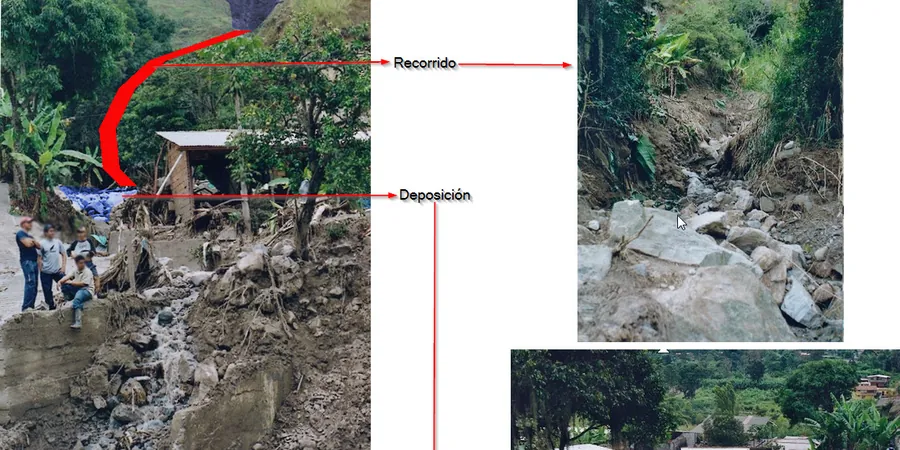
Geomorphological mapping of scarps, lobes, and deposition zones
Back-analysis of past events to calibrate the FLO-2D or RAMMS model
Trigger thresholds based on rainfall intensity-duration curves for the region
We also evaluate how the debris flow interacts with existing infrastructure — retaining walls, culverts, and road embankments. In several gullies near Albany, we identified that the colluvium layer reached up to 6 m thick, requiring a focused slope stability analysis to define the critical failure surface before mitigation design.
Technical reference image — Auckland
Regional considerations
In Auckland, we often see that debris flow hazards are underestimated because the scars are quickly re-vegetated by manuka and tree ferns, hiding the evidence of past events. A resident may not realize that the gentle-looking gully behind their property has produced a 500 m³ flow twice in the last 30 years. The real risk is not just the flow itself but the sudden loading on downstream structures — a debris flow can impact a house with the force of a truck at highway speed. Our analysis maps the runout zone with a 1.5 m topographic resolution LiDAR, identifies buildings within the hazard footprint, and recommends deflection berms or debris basins sized per the computed volume.
Field-based geomorphological mapping combined with FLO-2D modeling to delineate initiation zones, transport paths, and deposition areas. Includes a hazard matrix (low, moderate, high) for each catchment.
02
Mitigation Design for Debris Flows
Structural design of flexible barriers, debris basins, and deflection walls sized per the computed flow volume and velocity. We provide construction-ready drawings and hydraulic calculations for consent applications.
Standards that apply
NZGS 2016 — Landslide Risk Assessment Guidelines, NZS 4203:1992 — General Structural Design and Design Loadings (seismic slope factor), AASHTO M 288-17 — Geotextile Specification for Erosion Control in Debris Basins
FAQ
What triggers debris flows in the Auckland region?
Most debris flows in Auckland are triggered by intense or prolonged rainfall that saturates the colluvium layer overlying the Waitematā Group sandstone or East Coast Bays formation. The 100-year ARI storm can deliver 120 mm in 24 hours, which is enough to mobilize loose material on slopes steeper than 25 degrees.
How much does a debris flow analysis cost in Auckland?
The cost typically ranges between NZ$2,340 and NZ$7,260, depending on catchment size, model complexity, and whether LiDAR data is already available. A basic desktop assessment for a single gully is at the lower end, while a full numerical model with field mapping for a multi-hectare subdivision sits at the higher end.
What data do you need to run the debris flow model?
We require a 1 m or 1.5 m LiDAR DEM, rainfall IDF curves for the specific catchment, soil classification from test pits or boreholes, and any historical landslide inventory for the area. If no inventory exists, we perform a field reconnaissance to map old scars and deposit lobes.
Location and service area
We serve projects across Auckland and surrounding areas.