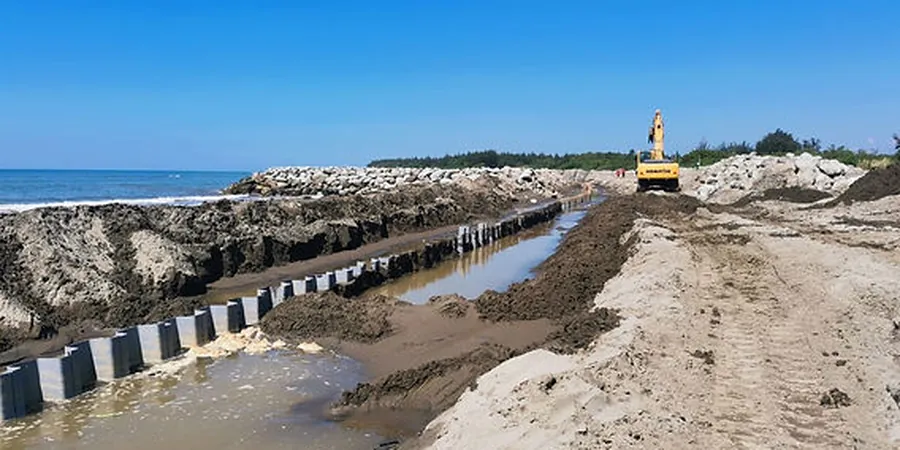
When designing a sheet pile wall in Auckland, the governing standards are NZS 3404 for steel structures and the NZGS guidelines for retaining walls, but the real challenge is the local ground profile. Auckland sits on the Auckland Volcanic Field, with basalt flows, tephra layers, and soft marine sediments around the Waitemata Harbour. These variable conditions mean a one-size-fits-all design simply won't work. A proper sheet pile wall design must account for the lateral earth pressures from both the retained soil and any surcharge loads, and in areas like the Viaduct Basin or Wynyard Quarter, the high groundwater table demands careful seepage analysis. Before we finalize any design, we typically recommend a MASW-Vs30 survey to map shear-wave velocity profiles across the site, ensuring the wall stiffness is matched to the actual ground stiffness.
A proper sheet pile wall design in Auckland must account for the variable ground stiffness and high groundwater table found across the isthmus.
Method and coverage
In Auckland, we often see that the biggest variable in sheet pile wall design isn't the wall itself but the soil-structure interaction at the pile tip. The soft pumiceous silts and organic clays found in the Hobsonville and Whenuapai areas can cause excessive toe kick if the embedment depth isn't calculated correctly for the local undrained shear strength. Our approach is to model the wall using limit equilibrium and finite element methods, calibrating the soil parameters against site-specific test data. For waterfront walls exposed to tidal fluctuations, we also incorporate a permeability test in the field to verify the hydraulic conductivity of the natural ground, which directly affects the drainage design behind the wall. The key deliverables include bending moment diagrams, deflection profiles, and a construction sequence plan that keeps the excavation safe at every stage.
Technical reference image — Auckland
Regional considerations
The coastal humidity and saline environment across Auckland's waterfront force us to take corrosion protection seriously. A sheet pile wall in the inner harbour faces chloride attack that can reduce the effective section thickness by 4–6 mm over a 50-year design life if not properly coated. Combine that with the soft marine clays that can settle under the wall's own weight, and you have a structure that needs both solid cathodic protection and careful bearing capacity verification. We always specify a minimum 2 mm corrosion allowance and require a geotechnical investigation that includes a trial pit or test pit to visually inspect the soil stratification before the wall design is finalized.
1.2 x retained height (soft ground) / 0.8 x retained height (competent basalt)
Allowable Lateral Deflection
H/200 for serviceability (max 50 mm)
Steel Grade
Grade 355 (NZS 4402 / AS/NZS 3678)
Corrosion Allowance
2 mm per exposed face (coastal zone)
Drainage Design
Weep holes at 1.5 m centres or continuous geocomposite drain behind wall
Related services
01
Cantilever Sheet Pile Walls
For excavations up to 6 m deep in Auckland's stiff tephra and basalt, we design cantilever walls with no tie-back anchors. We calculate the passive resistance from the soil in front of the wall to achieve the required factor of safety against rotation.
02
Anchored & Tied-Back Sheet Pile Walls
When the retained height exceeds 6 m or the wall is in soft marine clay, we design anchored walls with one or two rows of ground anchors or waler beams. Each anchor is proof-tested to 1.5 times the design load.
03
Combined Wall Systems (Sheet Pile + King Pile)
For deep basements in the Auckland CBD where space is tight, we combine sheet piles with king piles and waling beams to create a stiff, watertight retention system. This is particularly effective when the wall also serves as the permanent building envelope.
How much does a sheet pile wall design cost in Auckland?
The cost for a full sheet pile wall design package in Auckland typically ranges from NZ$2.480 to NZ$9.760, depending on the wall height, number of anchors, and the complexity of the ground conditions. This includes the structural calculations, bending moment diagrams, and a construction-ready design report.
What is the typical design life for a sheet pile wall in Auckland's coastal environment?
For permanent walls, we design for a 50-year service life. In the saline coastal environment of the Viaduct Basin or Tamaki River, we specify a minimum 2 mm corrosion allowance and often recommend a hot-dip galvanized or epoxy-coated pile to meet that lifespan.
Can a sheet pile wall be used as the permanent building wall in Auckland?
Yes, it's common in Auckland's CBD for basement retaining walls. The sheet piles act as both temporary excavation support and permanent structural wall. The design must comply with NZS 3404 and include a waterproofing membrane on the soil side to prevent moisture ingress into the finished basement.
Location and service area
We serve projects across Auckland and surrounding areas.